
The idea for this project arrived while I was reading ChatGPT’s assessment of one of my recent runs.
It did not feel like the usual automated summary telling me how far I had run, how quickly I had covered the distance or whether my heart rate was unusually high. My ChatGPT running coach examined the complete session. It knew what had been prescribed. It could see what I had actually done. It had the original Garmin FIT file, the exports from my own Plus50Fit FIT Tool, my heart rate, pace, cadence, laps, weather, RPE and personal notes.
It considered the run before telling me what the run might mean.
That made me wonder what other runners were searching for. Were they asking ChatGPT for a one-off training plan, or were they finding ways to create an ongoing coach and athlete relationship supported by real activity data?
I am attempting the second.
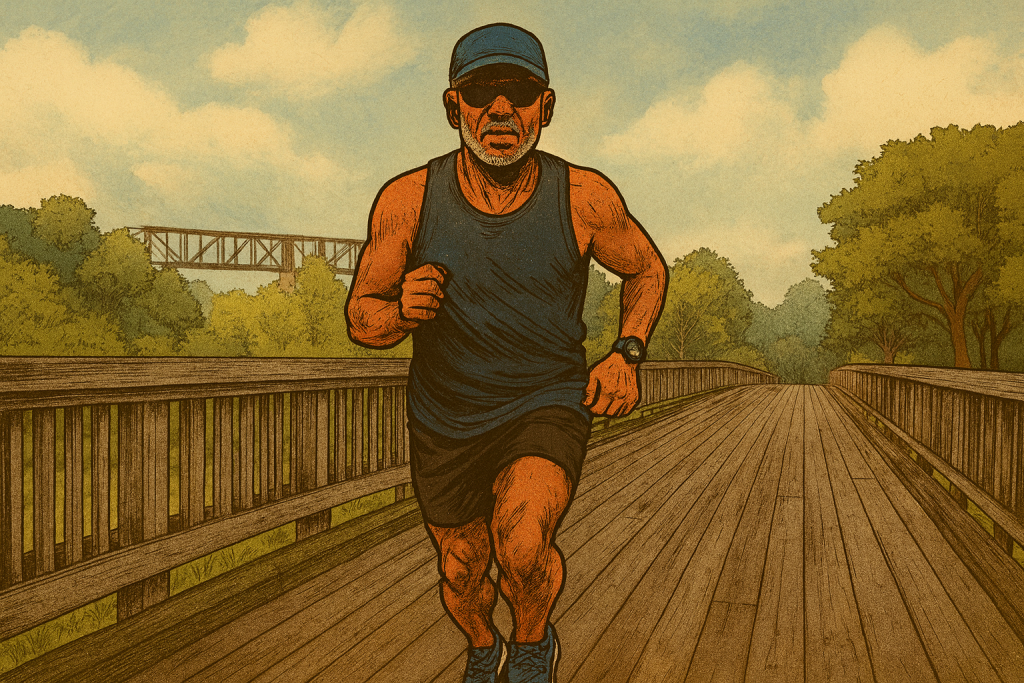
This Is Not “Write Me a 10K Plan”
A person can open ChatGPT and type, “Write me a 10K training plan.” Within seconds, something organized and confident will appear.
That can be useful. It can also be dangerously incomplete.
The response does not automatically know how old you are, what you have been running recently, how much training you can tolerate, where you have been injured, whether your heart-rate zones are accurate, how you slept or why yesterday’s easy pace felt like work.
I wanted something deeper than a printable schedule.
I wanted ChatGPT Coach to know what it had assigned, examine how I executed it, consider the numbers and my experience together, and use that information when prescribing what came next.
The result is an evolving system rather than a single clever prompt.
Why I Am Trying This at 67
I am training for the BlackToe Holiday 10K in December. I will be 68 by race day.
This training block follows another round of interruption, discomfort and rebuilding. That is not an unfamiliar story. I have had good races, disappointing races, injuries, comebacks and more than a few reminders that ambition and readiness do not always arrive on the same morning.
My earlier Ouch to 10K pivot documented what happened when marathon ambitions had to give way to recovery and a more realistic short-distance target. The current BlackToe block continues that story, but with a more structured AI-assisted coaching system.
BlackToe is not the endpoint. If health and circumstances cooperate, I want to focus on 10Ks and half marathons next year, then consider a fall marathon as a celebration of turning 70.
That longer horizon changes the question. I am not simply asking whether AI can make me faster by December. I am asking whether it can help me train more thoughtfully, understand my own responses and preserve the consistency required to keep running as I age.
What My ChatGPT Running Coach Knows
The quality of AI coaching depends heavily on the quality of the information surrounding each run.
My Coach Chat can work with:
- My recent running history and current training phase
- My race goal and available training days
- Individualized heart-rate zones
- Garmin FIT activity data
- Heart rate from a chest strap
- Pace and cadence
- Laps, splits, pauses and workout sections
- Weather and environmental conditions
- Sleep, readiness and general fatigue
- Pain or discomfort
- Pre-run expectations
- During-run observations
- Post-run RPE and debrief
- The planned workout compared with the actual execution
- Relevant strength training and cross-training
- Previous assessments from the same training block
That is a long way from, “I am 67. Give me a plan.”
For readers who find the alphabet soup of training data intimidating, my Training Metrics Made Simple guide explains many of the numbers I use and why they matter after 50.
The Run ID: A Small Detail That Holds Everything Together
Each prescribed workout receives a persistent run ID, such as:
BT_WK04-01 | Easy Reset
The run ID connects the original prescription to the Garmin activity, the FIT exports, my runner context and the coach’s assessment.
That may sound like filing-cabinet fussiness, but it solves a real problem. Without a reliable identifier, it becomes easy to compare the wrong activity with the wrong prescription, especially after several weeks of training.
The ID creates a traceable chain:
- Coach prescription
- Run ID
- Garmin activity
- FIT data
- Runner context
- Coach assessment
- Longitudinal training record
The point is not to make running bureaucratic. The point is to let the analysis answer a basic question honestly: Did I complete the session that was prescribed, and what happened when I tried?
A Plan for Me and a Plan for the Machine
ChatGPT Coach produces two synchronized versions of my weekly plan.
The first is human-readable. It tells me what to do, how hard it should feel, what heart-rate range to use where appropriate and what the purpose of the workout is.
The second is a machine-readable JSON prescription that my FIT Tool can import.
Both versions contain the same run IDs and workout structure. After the run, the tool uses the prescription and the Garmin activity to help compare planned versus actual execution.
This is one of the areas where AI has been particularly useful. I did not begin this project as a software developer preparing a commercial product. I had a problem, described what I needed and worked with ChatGPT to build a personal Python application.
Could another runner ask AI to build something similar? Absolutely. That is part of the opportunity. The application may eventually be useful as shared code, a build prompt or a free starter kit. The larger value, however, is the nudge: an ordinary runner can build a tool around a real personal need.
What the FIT Tool Adds
A Garmin FIT file can contain far more information than the summary screen on a watch. Depending on the device and activity, it can include timestamped heart rate, speed, distance, cadence, laps, events, pauses and other records.
My FIT Tool helps preserve and export that information in forms Coach Chat can examine. It also lets me add the information Garmin does not know.
Garmin may know that my heart rate climbed. It does not necessarily know that I slept poorly, started with an ache, encountered unexpected heat, deliberately slowed down or felt much better than the pace suggested.
The data needs the story. The story also needs the data.
I have already written about what happens when algorithms make confident predictions without enough context in Race Predictions: What Happens When AI Ignores Your Long Runs. That same problem applies to coaching. Numbers without purpose can be misleading. Feelings without objective evidence can also fool us.
What ChatGPT Does Well
So far, ChatGPT is especially useful for:
- Organizing a large amount of information
- Comparing the prescribed workout with the completed activity
- Examining pace, heart rate, cadence and RPE together
- Explaining training concepts in plain language
- Noticing patterns I might overlook
- Asking whether weather, fatigue or terrain changed the meaning of a result
- Revising future workouts when circumstances change
- Keeping a written record of the reasoning behind a decision
- Helping me build tools and templates for the process
It is also available when the question occurs to me. That convenience matters.
What ChatGPT Does Poorly
ChatGPT can sound certain when it should be cautious. It can make calendar mistakes, arithmetic mistakes and training recommendations that look plausible without being appropriate. It can also be too agreeable.
A published study of ChatGPT-generated running plans found that more detailed athlete information improved the plans, but coaching experts still did not rate even the most detailed plans as optimal. Important weaknesses included progression, contextual monitoring, testing and the absence of the normal feedback questions found in a coach and athlete relationship.
That finding supports my approach, but it does not prove my system is safe or effective. More information can improve the output. It cannot turn a language model into a doctor, physiotherapist or experienced human coach watching me move.
The system also depends on me. If I omit discomfort, exaggerate readiness, upload bad data or ask a poorly framed question, I can receive a polished answer built on a faulty foundation.
Where Human Judgment Remains Necessary
I am not a running coach, medical professional or exercise physiologist. I am an experienced recreational runner who has had his share of injuries, interruptions, comebacks and lessons learned the uncomfortable way.
I use my training as an ongoing N=1 experiment. I combine personal experience, Garmin data, current research and AI-assisted analysis. ChatGPT helps me organize information, examine patterns and question my assumptions. It does not diagnose injuries or replace qualified medical advice.
I recommend working with an appropriate human professional, especially if you are new to running, returning after injury, managing a health condition or attempting an ambitious goal.
Human judgment is not a failure of the system. It is one of the required inputs.
Running by Feel Still Matters
All this data could easily become another trap.
I have previously experimented with switching off some of the alerts and running by feel. That experience matters now because RPE is not a decorative field added after the numbers. It is evidence.
If a workout was supposed to feel easy but required concentration and grit, the pace alone does not get to declare it easy. If heart rate was elevated on a hot day but breathing remained controlled, that context belongs in the interpretation.
The goal is not to surrender every decision to a watch or an AI. It is to improve the conversation between the numbers, the runner and the plan.
What BlackToe Will Test
The BlackToe Holiday 10K turns this project into a real-world case study.
Between now and race day, I intend to document:
- What the coach prescribed
- Which sessions I completed
- How closely execution matched the plan
- When and why the plan changed
- What the objective data suggested
- What my subjective feedback added
- Mistakes, failures and questionable measurements
- Changes in fitness, efficiency and consistency
- The race result
- Whether the complete system proved useful enough to continue
One 10K will not scientifically validate AI running coaching. I am one runner, following one evolving system, through one training block.
But it can produce something more useful than a hypothetical prompt article. It can produce evidence that readers can inspect.
Follow the Experiment
This is the beginning, not the victory lap.
Over the coming weeks, I will explain what information I give my ChatGPT running coach, how my FIT Tool works, what I report after each run, where AI coaching breaks down and whether the system changes in response to real training.
After BlackToe, I will publish the results, including the things that did not work.
I do not know yet whether AI will help me run a faster 10K. I do know that it has already helped me ask better questions about my training.
At 67, with 68 coming fast and 70 visible in the distance, that may be the most valuable place to begin.
AI DISCLOSURE
This article was researched and drafted with AI assistance under my direction. I reviewed, corrected and approved the final content based on my personal training records and lived experience. AI is also part of the subject of this experiment. Wherever possible, I preserve the original coaching prescription, activity data and subsequent assessment so readers can distinguish what was planned, what occurred and what I concluded.
SAFETY AND PRIVACY NOTE
Upload only activity files that belong to you. Garmin FIT files and exported data may contain routes, locations, timestamps and other personal information. Review what you share. AI cannot diagnose an injury or replace a qualified medical professional or experienced human coach.
Frequently Asked Questions
Can ChatGPT be used as a running coach?
ChatGPT can help create and revise training plans, explain workouts and analyze information supplied by a runner. Its usefulness depends heavily on the quality and continuity of that information. It should not be treated as a medical professional or an infallible replacement for a qualified coach.
Can ChatGPT read Garmin FIT files?
ChatGPT can sometimes work with uploaded files or with data extracted from them, depending on the tools and environment available. I use a custom Plus50Fit FIT Tool to preserve and export Garmin activity data in structured forms that can be connected to the original coaching prescription.
What should I tell ChatGPT before requesting a running plan?
Useful context includes age, recent training, current weekly volume, race goal, available days, injury history, health considerations, heart-rate zones, strength work, cross-training and how recent workouts have felt.
Is an AI running coach safe for older runners?
Age alone does not determine whether a plan is safe. Training history, health, medications, injury history, recovery and current capacity all matter. Older runners should use appropriate medical and coaching support rather than relying on AI alone.
Does this prove that ChatGPT is an effective running coach?
No. This is an N=1 case study involving one runner and one evolving workflow. The BlackToe result and the complete training record will help me judge whether the system was useful in my circumstances.
[…] AI Running Coach Experiment […]
[…] AI Running Coach Experiment […]
[…] AI Running Coach Experiment […]
[…] AI Running Coach Experiment […]
[…] AI Running Coach Experiment […]
[…] AI Running Coach Experiment […]
[…] AI Running Coach Experiment […]
[…] AI Running Coach Experiment […]
[…] AI Running Coach Experiment […]
[…] AI Running Coach Experiment […]
[…] AI Running Coach Experiment […]