
My Garmin can give me a running cadence number precise to one decimal place. The internet can then tell me that the number should be 180 steps per minute.
That’s how a useful metric becomes a commandment.
At 68, I’ve become a late-blooming running-data nerd. I like opening a Garmin FIT file and following the relationship among pace, heart rate, cadence and what I felt on the road. I also genuinely like running. I find the data a fascinating second layer of the experience, not a judge deciding whether the run counted.
Cadence fits that balance perfectly. It can help me see whether my rhythm stayed recognizable, whether fatigue or a walk break changed the pattern and whether a form adjustment deserves investigation. What it cannot do is tell every runner, at every pace, on every body and at every age, to land on the same number.
During my BlackToe Holiday 10K rebuild, my useful easy-running sections have often sat around the high 150s to low 160s. I am not embarrassed by that number, and I’m not planning to sprint my feet underneath me simply to make the watch display look more athletic.
I’m not asking, “How do I force my cadence to 180?” Instead, “What is my cadence telling me about this run, and is there a good reason to change it?”
Why 180 Steps per Minute Became Running Folklore
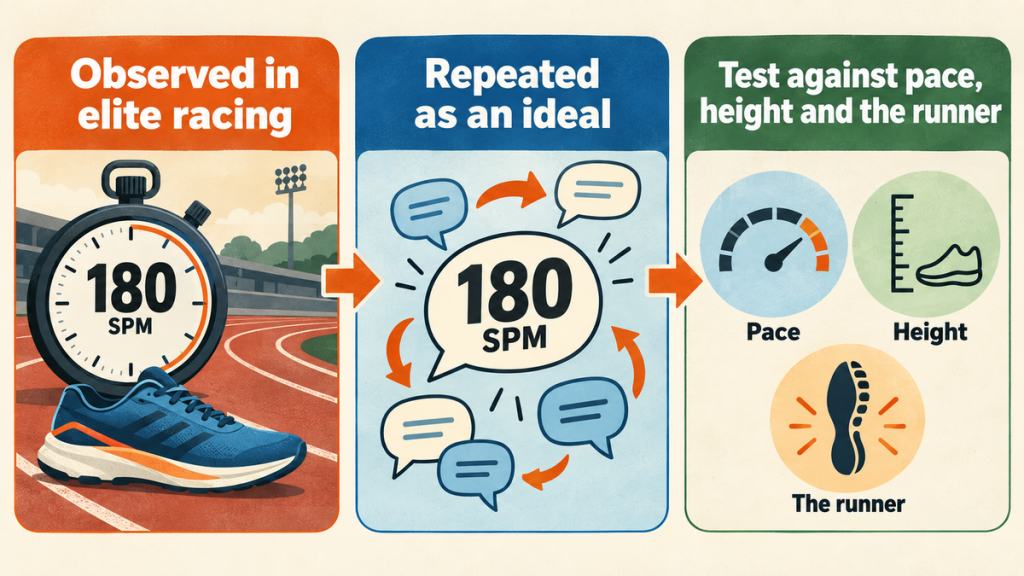
The 180-SPM idea is usually traced to coach Jack Daniels counting the step rates of elite distance runners at the 1984 Olympics. It was an observation of fast, highly trained athletes while racing. It wasn’t a clinical threshold, an age-adjusted formula or a universal instruction for recreational runners jogging at easy pace.
The group observation becomes an ideal. The ideal becomes a target on the watch. Before long, a runner moving comfortably at 158 SPM is told that something is wrong because an Olympian racing much faster once took more steps.
A current cadence explainer from Runner’s World makes the missing point: cadence changes with speed, and height also helps explain why runners can use different step rates. Garmin defines running cadence as the number of steps taken by both feet in one minute. Garmin also notes that 180 is often cited, while taller runners tend to have somewhat slower cadence.
Even Garmin’s colour gauges need context. The company says its running-dynamics reference data came from steady outdoor runs faster than 7:00 per kilometre, and that pace, height, hills, fatigue and individual running style affect the metrics. Most of my current easy running is slower than that reference cutoff. A colour band built from faster runners is context, not a report card.
What Cadence Actually Measures
Cadence is simply step rate. If I take 160 total steps in a minute, my cadence is 160 SPM.
Speed comes from the combination of cadence and step length. I can run faster by taking more steps, covering more ground with each step, or changing both. That is why cadence rarely makes sense without pace beside it.
My cadence will usually rise when I speed up. It may also change on hills, around corners, on uneven ground, during walk breaks and as I settle into a run. If the watch averages all of that together, the tidy session number may hide the useful pattern underneath.
The Garmin FIT file article explains why I care about the timeline. A session average can tell me how the activity ended. The timestamped records can show where running began, where walking interrupted it and whether cadence held together during the section that actually answered the workout’s purpose.
Step rate is not the same as good form
A higher cadence can shorten step length at the same speed, but it doesn’t automatically fix posture, stiffness, strength, pain, foot placement or every other part of running mechanics. A runner can hit 180 and still move poorly. Another can sit below 180, run comfortably and have no reason to overhaul a natural gait.
Cadence is one clue. It is not a full gait assessment compressed into three digits.
What Changes for Runners Over 50
Age doesn’t create one correct cadence either.
A systematic review of runners over 50 found consistent age-related biomechanical differences, particularly reduced ankle joint power and moments compared with younger runners. The review did not conclude that older runners should all solve those differences by chasing one step rate. It showed that masters running mechanics deserve their own questions instead of being judged entirely against younger athletes.
That matters to me because my current rebuild is not only cardiovascular. Strength, power, tissue capacity, balance, recovery, old injuries and confidence all sit underneath the stride. My minimum-strength framework treats “spring” as one movement need, but it doesn’t tell every older runner to begin hopping or changing form on Monday.
If an older runner’s cadence is comfortable, stable and pain-free, age alone is not a reason to manipulate it. If there is persistent pain, obvious overstriding, repeated late-run breakdown or a professional gait assessment identifies a useful target, a small change may be worth testing. I’ve been there.
What the Cadence Research Supports, and What It Doesn’t
Research nerds, proceed at your own risk.
There is a real evidence-based idea underneath the folklore. Increasing a runner’s preferred step rate by a modest amount, often about 5 to 10 percent in studies, can shorten the step and change loading at the hip, knee and ankle when speed is held constant.
In a 2011 laboratory study, 45 recreational runners ran at their preferred cadence and at rates 5 and 10 percent above and below it. Small increases shortened their steps and reduced some knee and hip loading measures. A 2022 systematic review and meta-analysis found similar biomechanical changes across a larger body of research. It also found that the evidence wasn’t strong enough to say that changing cadence prevents injuries or improves performance.
It doesn’t prove that every runner with a lower cadence is injured, or that increasing cadence prevents all injuries. In the same 2022 review, direct injury evidence was very limited. Another systematic review found that runners with and without an overuse-injury history had similar average cadence.
A 2025 cadence review described consistent biomechanical changes and promising clinical uses, while still calling for stronger prospective research on long-term injury prevention. That is the honest middle ground. Cadence retraining can be a useful tool for a particular runner and problem. It is not universal armour.
Changing load is still changing load
Shorter, quicker steps may reduce some loads, but the demand doesn’t disappear. It can shift. Calves, Achilles tendons, feet and the rest of the chain still have to tolerate the new pattern.
That’s one reason I wouldn’t jump from 158 to 180 SPM because a chart made me nervous – actually, I have tried. That is roughly a 14 percent increase, introduced before we’ve even established that my natural step rate is a problem.
If I ever test a cadence change, I want it to be small, purposeful, gradual and evaluated beside symptoms, pace, effort and recovery. New or worsening pain deserves qualified assessment, not an internet metronome.
What My BlackToe Runs Actually Showed
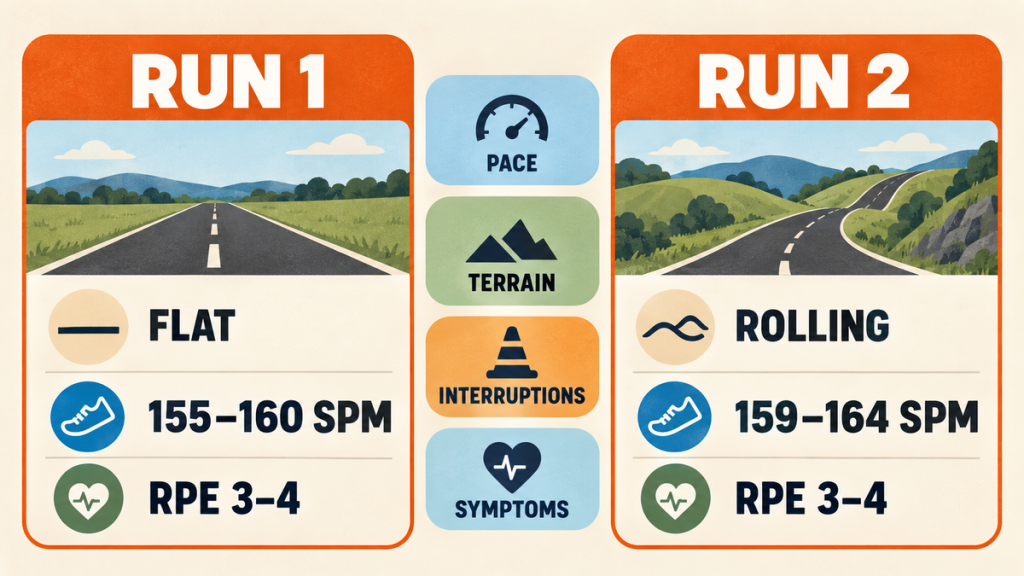
Two Week 4 runs gave me a better cadence lesson than the session averages did.
In the first run, I completed a 40-minute aerobic-control workout on a flat road. During the useful continuous kilometres, my pace progressed from about 8:29 to 8:13 per kilometre. My cadence sat at roughly 155, 160 and 159 SPM. My overall RPE matched the prescribed 3 to 4, I breathed exclusively through my nose and my running rhythm remained stable.
In the second run, I completed a 45-minute easy-endurance session on gently rolling road and trail. My cadence sat around 159 to 164 SPM during representative running windows. My pace varied, I had a few brief interruptions, my readiness was only 2 out of 5 and a tight mid-back affected my breathing early. Even so, I saw no obvious late-session mechanical collapse in my cadence.
Both runs also had faulty early heart-rate data. That made cadence more useful to me as an independent mechanical clue, but it didn’t turn cadence into a verdict. I explored the same mismatch in what Strava missed about one of these runs. CoachChat helped me separate what the prescription asked for, what Garmin recorded, what I reported and what could reasonably be inferred.
What I took from the assessment was modest. I completed the assigned endurance work, kept my effort controlled and held my rhythm together once I was running. I saw nothing in either run that justified chasing a new cadence target.
The number changed with the run
The useful lesson was not that 160 is now my ideal. It was that cadence behaved sensibly beside pace, terrain, interruptions and feel.
A faster kilometre carried a somewhat quicker rhythm. A rolling route and social stretch produced variation. Walk or stationary moments created brief collapses in the trace that would look alarming if I forgot they were not running.
Context rescued the number from nonsense.
Why My AI Coach Doesn’t Prescribe 180
My cornerstone AI running coach experiment begins with the purpose of the workout, not the prettiest metric. For an easy run, I want the assigned time or sections completed at the intended RPE, with breathing, mechanics and symptoms behaving appropriately.
Cadence then becomes evidence. It can help answer questions such as:
- Did my running rhythm settle after the warm-up?
- Did cadence fall while pace and effort stayed the same, suggesting fatigue or altered mechanics?
- Did a faster pace arrive through a natural change in both step rate and step length?
- Did walking, traffic or a route interruption contaminate the average?
- Did pain appear at the same time the cadence pattern changed?
Those are better coaching questions than, “Was the number green?”
The same principle guides my provisional heart-rate zones and my pace-at-the-same-heart-rate comparisons. A metric earns influence when the signal is credible, the context is preserved and several pieces of evidence agree.
When I Would Consider Changing Cadence
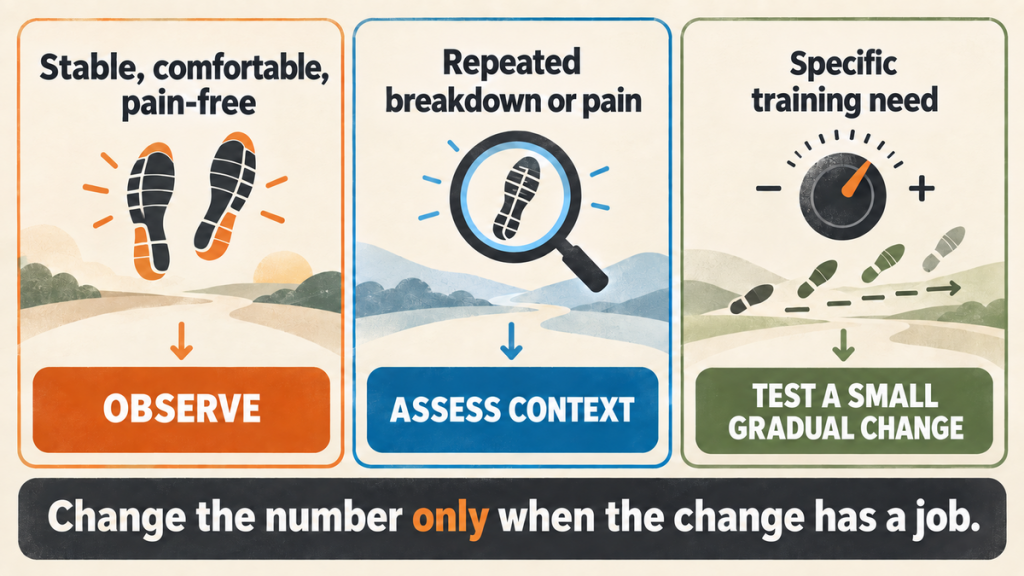
I would consider a small cadence experiment when:
- A qualified clinician or coach identifies overstriding or a loading pattern related to a specific symptom.
- Pain or repeated mechanical breakdown appears alongside the same cadence and pace pattern.
- Video or gait assessment gives us more than a watch average.
- The change can be tested gradually without disrupting the rest of the training block.
- We define success in advance, such as less pain or improved control, instead of merely reaching a higher number.
I would be less interested in changing cadence when the only reason is comparison with an elite-racing observation, a device colour or another runner of a different height moving at a different pace.
I’m not running to a metronome right now
Metronomes and music can help some runners practise a small step-rate change. I haven’t run with my Shokz or phone in months, so neither is currently part of my routine. I expect to carry the phone again as the runs become longer, mainly for safety and contact, but I am not eager to make every easy run a rhythm drill.
If I need to reassess my cadence for any reason, I can use a short controlled section, watch alert or external cue. Until then, I’d rather keep it easy.
How I Plan to Use Cadence Without Serving It
My training metrics guide for runners over 50 explains the common numbers.
For cadence, I plan to keep five rules:
- Compare cadence only within similar running sections and paces.
- Separate running from warm-up, walking, stops and cooldown.
- Look for a personal range and trend, not one universal target.
- Keep RPE, breathing, pain, terrain and footwear beside the trace.
- Change cadence only for a defined reason, then evaluate the whole response.
I can still follow the evidence from beginning to end: CoachChat’s prescription → the Garmin FIT file → what I felt and reported → the post-run assessment → patterns across several runs.
My local Plus50Fit FIT Tool already preserves cadence beside pace and heart rate, along with my notes about how the run felt, the conditions, interruptions and anything else the device couldn’t know. Run Compare can then examine the relationships among pace, heart rate and cadence across comparable sections, and warn me when two runs don’t belong side by side. I may eventually turn this experiment into free Windows tools readers can try on their own computers, but that’s still a possibility, not a release promise.
Cadence is one clue among pace, effort, breathing, symptoms and everything else I use to decide whether the run was solid.
My Answer to the 180-SPM Question
I don’t think 180 steps per minute is a useless number. It’s a historically interesting observation, a common reference and a natural cadence for some runners at some speeds. I’ve chased it!
At this stage of the BlackToe rebuild, I’m locked into a stable cadence in the high 150s or low 160s during slow easy running. My breathing is controlled and my RPE is where it needs to be.
If I boost my pace, my cadence will rise with it. I’ve seen that in previous blocks. If a symptom or gait assessment gives me a reason to test a change, I can do that carefully. Until then, I’ll sit where I am, boost the engine before chasing 180.
Frequently Asked Questions
Is 180 steps per minute the ideal running cadence?
No universal ideal has been established for every runner and pace. Cadence varies with speed, height, terrain and individual mechanics. A modest increase may help a specific biomechanical or clinical goal, but 180 SPM is not a compulsory threshold.
Does running cadence decrease with age?
Running mechanics do change with age, and research in runners over 50 shows differences in lower-limb power and loading compared with younger runners. That does not produce one age-based cadence target. Pace, strength, injury history and the individual runner still matter.
Should I increase my cadence if it is below 170?
Not because of the number alone. If you are comfortable, pain-free and moving well, a lower cadence may simply reflect your easy pace and body. If pain, overstriding or repeated form breakdown is present, a qualified professional may suggest a small, gradual trial.
Can Garmin cadence tell me if my form is good?
It can show step rate and how that rate changes through a run. It cannot assess the whole gait or explain why the number changed. Use cadence beside pace, terrain, interruptions, symptoms and, when needed, video or professional assessment.
Can AI safely change my running form?
AI can organize evidence, compare sections and help frame questions. It cannot examine tissues, perform a clinical gait assessment or guarantee that a change is safe. Form changes linked to pain or injury belong with an appropriate qualified professional.
AI disclosure: I use ChatGPT as part of this N=1 running-coach experiment to help organize prescriptions, Garmin-derived evidence, runner context, research and draft analysis. I review the conclusions and remain responsible for training decisions and the final published wording.
Safety disclaimer: This article documents one recreational runner’s experience and is not medical advice, diagnosis or a substitute for individualized coaching, physiotherapy or clinical care. Running-form changes can redistribute load. Stop or modify exercise and seek appropriate qualified help for severe, unusual, worsening or movement-altering symptoms. Garmin is not affiliated with or responsible for Plus50Fit.