
I do not want to add sodium when I cook.
That’s the rule I’ve settled on in my own kitchen. Table salt, sea salt, kosher salt, potassium-chloride substitutes and MSG are all off the table. So are high-sodium sauces or seasoning blends sneaking in through the side door.
That doesn’t mean every ingredient I eat contains zero sodium. Sodium occurs naturally in food, and restaurant meals are another world entirely. When we eat out, I try to make a wise choice and carry on with my life. At home, though, I don’t reach for added sodium to make food taste good.
This came out of my blood-pressure journey. Prescribed medication had brought my readings into a high-normal range. Regular exercise and nutrition-related weight reduction were part of the picture too. Then I moved toward a no-added-salt, generally lower-sodium way of eating, and I noticed the most striking change in my own readings.
That’s my observation. It isn’t proof that sodium reduction caused the change by itself. I changed more than one thing, I still take my prescribed medication, and I wouldn’t tell anyone to change medication because of something that happened to me. What I can say is that the experience got my attention.
Current guidance supports sodium reduction as one useful part of blood-pressure management. Hypertension Canada recommends combining a healthy eating pattern, regular activity, healthy weight and prescribed treatment, and the World Health Organization recommends that adults consume less than 2,000 mg of sodium per day. A randomized crossover trial in middle-aged and older adults also found that a lower-sodium diet reduced blood pressure for most participants, including many already taking medication.
Fine. The health case matters. But dinner still has to taste like dinner.
Salt Was Doing More Work Than I Realized
When people say, “Just leave out the salt,” they make it sound as if salt contributes one simple taste that can be removed like a garnish.
Salt does more than make food taste salty. It can enhance other flavours, suppress bitterness, increase perceived savouriness, help some foods seem juicier and make a dish feel rounded and complete. Sensory research on sodium reduction describes those overlapping effects, which helps explain why one supposed replacement often disappoints.
If I remove something that was doing five or six jobs, I can’t expect one squeeze of lemon to do all five or six.
That changed the question for me. I stopped asking, “What tastes exactly like salt?” and started asking, “What job is missing from this food?”
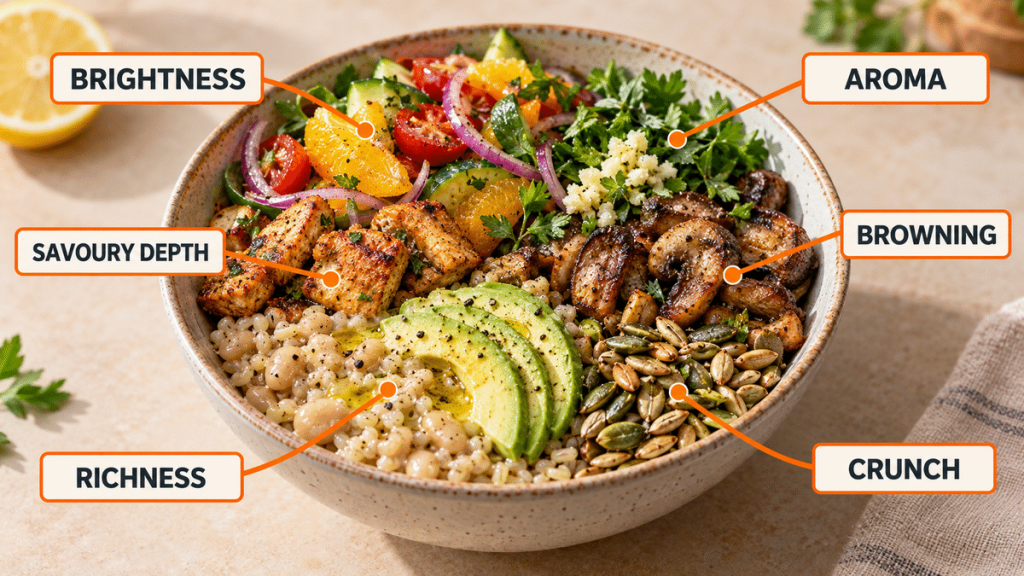
Sometimes it needs brightness or aroma. On another plate, the missing piece might be savoury depth, better browning, a little richness or something crisp. Most often, it needs a combination.
My working framework is:
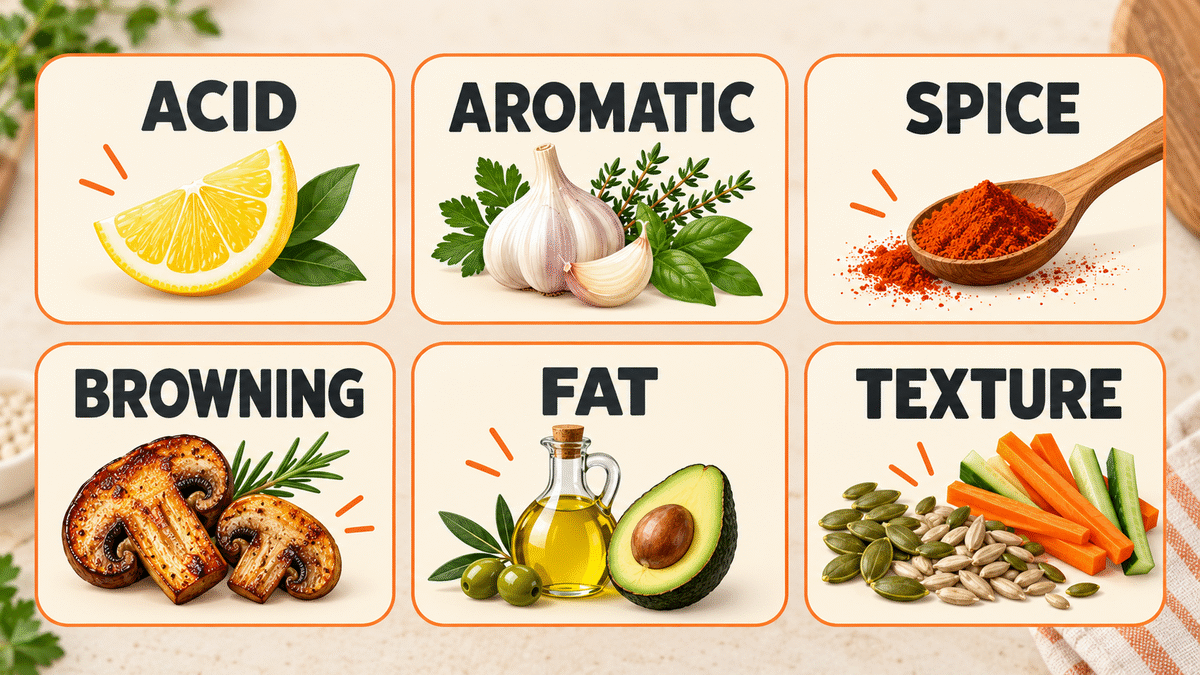
Acid + Aromatic + Spice + Browning + Fat + Texture
Not every dish needs all six in equal measure. It’s a checklist, not a chemistry formula.
Acid Brings Food Back Into Focus
Acid doesn’t create saltiness, but it can wake up flavours that seem muted. Lemon juice, lime juice and vinegar bring brightness and contrast. Citrus zest adds aroma without adding more liquid.
I often use zest before cooking and juice near the end. Zest can sit in a dry rub with garlic, pepper and smoked paprika. A finishing squeeze of juice is more like turning on a light after the cooking is done.
Lemon works naturally with fish and chicken. Lime perks up beans, rice and roasted corn. Balsamic vinegar can give roasted vegetables sweet-sour depth. Red wine vinegar can sharpen a tomato sauce. Apple cider vinegar is excellent with lentils.
The trick is not to make everything taste sour. Add a little, taste the complete bite, then decide whether the food has come into focus.
Aromatics Make Food Smell Like Something Is Happening
A large part of flavour is aroma. Garlic, onion, shallot, ginger, scallion and fresh herbs begin working before the fork reaches my mouth.
They also change character depending on how I treat them. Raw garlic is sharp. Roasted garlic is sweet and mellow. Raw onion bites. Slowly browned onion becomes deep and almost jammy. Scallions added at the end give a fresh top note that long cooking would erase.
This is one reason I don’t treat “add garlic” as a complete instruction. Do I want bite, sweetness or background depth? The answer changes when I add it and how I cook it.
Aromatic combinations I return to include rosemary, garlic and lemon zest for potatoes; ginger, garlic and scallion for rice or chicken; basil added at the end of tomato sauce; and shallot with vinegar and olive oil for a no-added-salt vinaigrette.
Spices and Heat Replace Some of Salt’s Snap
Salt gives food a quick sensory signal. Spices can create a different kind of signal through warmth, pungency, smoke and heat.
Black pepper brings bite. Smoked paprika adds warmth and the suggestion of fire even when I haven’t gone near a grill. Cumin and coriander add earthy depth. Chile flakes provide a little spark. Mustard powder adds sharpness without the sodium that can hide in prepared mustard. Turmeric adds earthiness and colour.
I’m not trying to bury bland food under a mountain of powder. Spices work best when they have a purpose and a supporting cast.
For example, chicken works well with smoked paprika, black pepper, garlic and lemon zest. Beans can take cumin, coriander, chile and lime. With fish, I might reach for coriander, pepper, citrus and herbs. Meanwhile, turmeric, cumin, ginger and scallion can wake up rice.
Packaged blends require a label check. “Herb seasoning,” “lemon pepper” and “chicken seasoning” can contain plenty of salt even when the front of the bottle looks wholesome.
Savoury Depth Without Added Sodium
MSG is off my list because it contains sodium. That’s a boundary for my cooking, not a claim that MSG is uniquely bad or that everyone should avoid it.
Fortunately, savoury depth doesn’t belong to one ingredient. Fresh mushrooms, unsalted mushroom powder, tomatoes, no-salt-added tomato paste, roasted vegetables and caramelized onions can all make food taste fuller.
Technique matters here. Mushrooms steamed in a crowded pan won’t develop the same flavour as mushrooms given enough heat and space to brown. Tomato paste becomes deeper when I cook it until it darkens. Roasting tomatoes concentrates them. Slowly cooking onions turns sharpness into sweetness and depth.
Nutritional yeast may fit, but I read the label. The same goes for mushroom powders and tomato products. “Natural,” “plant-based” and “healthy” are marketing words, not sodium measurements.
Fat Supplies Body and Satisfaction
Low-sodium food can taste sharp or thin when it lacks enough richness. A modest amount of extra-virgin olive oil, avocado, unsalted nuts or unsalted seeds can carry aroma, soften acidity and make the food feel more complete in the mouth.
This isn’t permission to pour half a bottle of oil over everything. Often a small amount in the right place is enough.
I might finish pasta with olive oil, add avocado to a bean bowl, blend white beans into a creamy sauce, or scatter toasted unsalted pumpkin seeds over roasted vegetables. Plain yogurt can make a useful sauce with citrus, garlic and herbs when its nutrition label fits the meal.
Fat isn’t salt, but mouthfeel is part of satisfaction. If I ignore that, I may keep adding acid and spice to a dish whose real problem is that it has no body.
Browning Builds Flavour That Seasoning Alone Can’t
This may be the biggest upgrade in my no-added-sodium kitchen: stop being afraid of colour.
Searing, roasting, caramelizing and toasting create flavours that were not present in the raw ingredient. Browning chicken adds savoury complexity. Roasting cauliflower concentrates sweetness and creates crisp edges. Toasting spices makes them more aromatic. Toasting unsalted nuts and seeds gives them deeper flavour as well as crunch.
I dry the surface of meat or fish before it hits the pan. I preheat the pan. I avoid crowding vegetables on a tray. Most importantly, I let food sit long enough to develop colour instead of nervously moving it every ten seconds.
Of course, browned is not the same as burned. There’s always that exciting little border between patience and smoke alarm.
Texture Can Rescue a Flat Plate
Taste and aroma get most of the attention, but texture changes how satisfying a meal feels.
Creamy beans topped with toasted seeds are more interesting than creamy beans alone. Crisp roasted vegetables over soft rice create contrast. Cucumber or radish beside tender fish adds crunch and freshness. Avocado against crisp raw vegetables gives softness and snap in the same bite.
I think texture matters even more when I remove salt because the plate needs other ways to hold my attention. Crunch, crispness, creaminess, chew and temperature contrast all count.
If everything in the bowl is beige, soft and the same temperature, the salt shaker is not necessarily the real problem.
Layering Is the Closest Thing to a Salt Replacement
The best no-added-sodium food usually doesn’t rely on one clever swap. It layers several effects.
For chicken, I can use garlic and onion for aroma, smoked paprika and pepper for warmth, proper roasting for browning, lemon for brightness and olive oil for body. My no-salt oven-roasted chicken thighs put that complete framework to work in one recipe, including crisp skin for texture.
For fish, I can use coriander, pepper, scallion, herbs, a browned exterior, lemon or lime, olive oil and crunchy cucumber.
For roasted vegetables, I can combine high heat, cumin, smoked paprika, caramelized onion, balsamic vinegar and toasted pumpkin seeds.
For pasta, I can brown mushrooms, cook garlic and onion, darken no-salt-added tomato paste, add chile flakes, finish with red wine vinegar and olive oil, then scatter fresh herbs on top. I don’t salt the pasta water under this rule.
For rice, I can toast the dry grains briefly, cook them with onion, ginger and spices, finish with lime and scallion, then add unsalted nuts or seeds.
For beans or lentils, I can start with browned onion and garlic, add cumin and coriander, use no-salt-added tomatoes, finish with vinegar or citrus and add avocado or seeds.
For salad, the combination might be vinegar, shallot, black pepper, olive oil, herbs, roasted mushrooms and something crunchy.
That’s why my six-part framework works better than a list of substitutes. It helps me build a complete bite.
Hidden Sodium Can Undo the Plan Quietly
Cooking from scratch gives me control, but packaged ingredients can bring in more sodium than their healthy image suggests.
I check canned beans and vegetables, broths, bottled sauces, Dijon mustard, spice blends, nutritional yeast, tomato products, prepared garlic, pickled foods, salad dressings and plant-based meats.
“No salt added” and “reduced sodium” are not identical. Reduced sodium means less than the regular version, not necessarily a small amount. I compare milligrams for similar serving sizes and think about how much I’ll actually use.
Health Canada’s nutrition-label guidance offers a quick rule: 5% Daily Value or less is a little, while 15% or more is a lot. That doesn’t make every choice for me, but it’s useful when I’m standing in an aisle comparing two cans.
What to Reach for Instead of the Salt Shaker
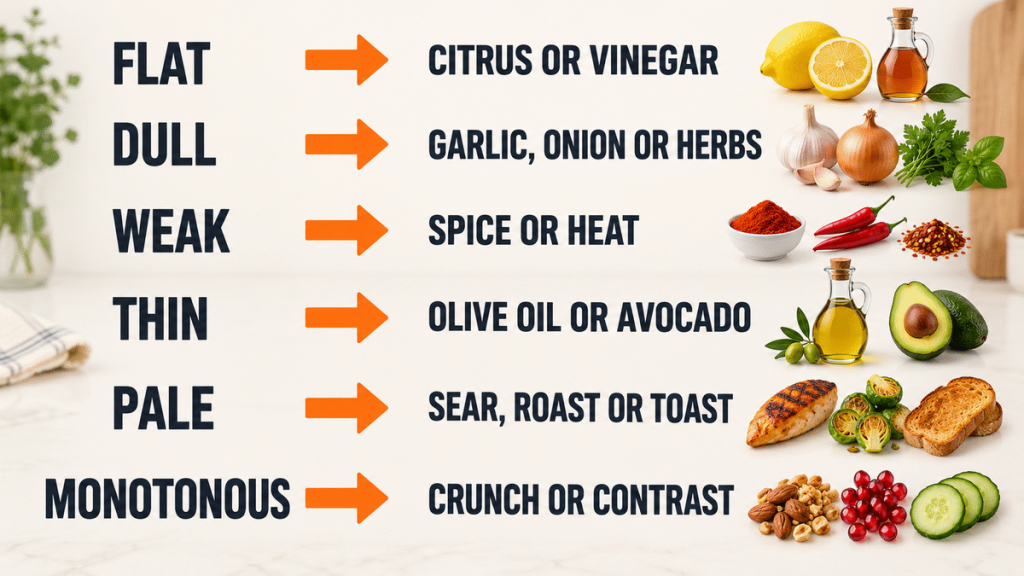
If the food seems flat, try lemon, lime, zest or vinegar.
If it seems dull, try garlic, onion, ginger, scallion or fresh herbs.
If it seems weak, try toasted spices, pepper, chile or mustard powder.
If it lacks savoury depth, try browned mushrooms, tomatoes, roasted vegetables or caramelized onions.
If it seems thin, try olive oil, avocado, creamy beans or a suitable yogurt.
If it looks pale and uninteresting, sear, roast, toast or reduce.
If it feels soft and monotonous, add unsalted nuts, seeds or crisp vegetables.
If it’s almost right, combine brightness, aroma and texture before dumping in more of anything.
My Practical Salt-Free Kitchen Formula
When a recipe says “add salt,” I pause and ask:
Does it need brightness?
Does it need savoury depth?
Does it need aroma?
Does it need warmth or bite?
Does it need richness?
Does it need better browning?
Does it need texture?
Does it simply need more cooking time?
Then I choose two or three tools that answer the actual problem.
In practice, I build the aromatic base, develop browning, add spices, concentrate savoury ingredients, add enough fat for body, finish with acid and add something fresh or crisp. I taste the complete bite, not just a spoonful of sauce by itself.
This Isn’t Bland Medical-Diet Cooking
I don’t want dinner to taste like something prescribed in a waiting room. I want it browned, bright, aromatic, savoury and complete. I just don’t want to use added sodium to get it there.
That doesn’t make me perfect. Restaurant meals happen. Naturally occurring sodium exists. Labels occasionally surprise me. The aim is a repeatable home-cooking rule that makes the healthier choice easier most days.
It fits the same long view behind my minimum strength training for older runners and my ChatGPT running coach experiment. I don’t think one workout, one metric or one ingredient is the magic answer. I’m trying to stack choices I can live with long enough to matter.
The P50Fit Recipes page is the practical companion to this article. This page explains the flavour framework, while the recipe collection shows it working across real meals, with no-added-sodium and low-sodium labels used carefully. The first recipe is my no-salt oven-roasted chicken thighs with lemon, garlic, oregano and paprika.
The Takeaway
Salt performs more than one job, which is why replacing it with one magic ingredient rarely works.
I’ve had better results asking what the food is missing. Brightness? Aroma? Savoury depth? Browning? Richness? Crunch? Once I answer that question, I can usually improve the dish without reaching for sodium.
This is what works for me. It has helped me eat in a way that supports my blood-pressure goals without treating flavour as collateral damage.
Frequently Asked Questions
Is cooking without salt the same as eating zero sodium?
No. Sodium occurs naturally in many foods, and packaged ingredients may contain sodium even when no salt is added during cooking. My rule is that I don’t add sodium as a seasoning, then I read labels and make lower-sodium choices where practical.
Is MSG a salt-free seasoning?
No. Monosodium glutamate contains sodium. Some people use it to reduce total sodium compared with ordinary salt, but it doesn’t fit my personal no-added-sodium rule. That’s a boundary, not a claim that MSG is uniquely harmful.
Should I use a potassium-chloride salt substitute?
That’s a question for a clinician or pharmacist who knows your health and medications. Potassium-based substitutes can be inappropriate for some people. I don’t use them, so this article focuses on flavour-building methods rather than a salt-like replacement.
Will my taste adjust to less salt?
People can become more accustomed to lower-sodium food over time, but I don’t think adaptation means waiting patiently for bland food to become acceptable. Better technique, aroma, acid, browning, richness and texture make the transition much more enjoyable.
Can reducing sodium replace blood-pressure medication?
No. Don’t stop or change prescribed medication based on an article or a home reading. Discuss meaningful dietary changes and changes in your blood-pressure pattern with your healthcare professional.
AI DISCLOSURE
I developed this article from my own cooking and blood-pressure experience with research and drafting assistance from ChatGPT. I reviewed the ideas, boundaries, sources and wording. The experience described is mine, and the health evidence is linked for readers who want to examine it.
SAFETY DISCLAIMER
This article shares one person’s experience and general food ideas. It isn’t medical advice. Sodium and potassium needs vary, especially with kidney disease, heart conditions and some medications. Don’t change prescribed medication or make a major therapeutic diet change without guidance from an appropriate healthcare professional.
[…] recipe is one practical example of how I cook without added sodium while still chasing flavour, satisfaction and a complete […]