
“Adaptive” might be the most attractive word in running technology right now. A plan that watches what I do, notices how I’m recovering and changes itself around real life sounds much better than a rigid PDF written for an imaginary runner.
I understand the appeal. My whole AI running coach experiment is built around the idea that a plan should learn from what actually happens. I don’t want CoachChat to hand me twelve weeks of workouts and then disappear. I want an ongoing conversation.
But I’ve also learned that adaptive can become reactive. One poor night’s sleep, one slow run or one suspect heart-rate trace shouldn’t make an AI coach panic and remodel the entire training block.
Sometimes the smartest adjustment is a smaller workout. Sometimes it’s an extra day. Sometimes it’s repeating a week. And sometimes the smartest adjustment is no adjustment at all.
That last option doesn’t sound very artificial-intelligence-ish. It doesn’t make the software appear busy. It may, however, be closer to good judgment.
Adaptive Isn’t the Same as Reactive
Running products increasingly promise adaptation. Garmin describes coaching that responds to performance and recovery. Garmin Connect+ adds Active Intelligence summaries to health and activity data. Runna now offers plan realignment after several missed workouts or a missed week. Strava’s Athlete Intelligence turns recorded activity data into explanations and trends.
The demand is obvious. Runners don’t live inside perfect calendars. We get sick, travel, sleep badly, miss sessions, feel unexpectedly good, feel unexpectedly awful and occasionally discover that the heart-rate strap is having a private crisis.
The tension is also obvious. In recent Garmin community discussions, runners complained that workouts changed too often, that a single poor sleep score could remove a planned harder session, and that they couldn’t see enough of the reasoning behind the change. Those discussions aren’t controlled research, but they reveal a practical search intent: runners want plans that adapt without becoming unpredictable.
That’s the line I’m trying to walk with CoachChat. I want a responsive plan, but I also want continuity. Training needs enough stability for one run to teach us something about the next.
My Rule: Make the Smallest Sensible Change
My working rule is simple:
Change only what the credible evidence requires, for only as long as the evidence supports.
That means an AI coach shouldn’t jump directly from “today felt harder” to “your fitness has declined.” It should first ask what the workout was supposed to accomplish, whether the data are believable, what I experienced and whether this is one odd day or part of a pattern.
This is where my post-run debrief becomes useful. The debrief connects the prescription, Garmin evidence, my own context, the assessment and the next decision. Without that chain, adaptation can become little more than an algorithm reacting to the loudest number on the screen.
Four Questions Before the Plan Changes
1. Did the Run Miss Its Actual Purpose?
An easy run isn’t a failed speed session. A recovery walk isn’t a failed long run. A comeback workout can be slow and still succeed completely.
Before changing anything, CoachChat has to compare the run with its assigned purpose. If the goal was controlled aerobic time at RPE 3 to 4 and I finished comfortably at RPE 4, the workout may have done its job even if pace was slower than last week.
2. Is the Evidence Credible?
A number doesn’t become trustworthy merely because Garmin recorded it. Heart rate can drop out. GPS can wander. Auto-pause can distort a summary. A whole-session average can mix walking, stopping, running and cooldown into one tidy but unhelpful value.
My Training Metrics Made Simple guide explains what the common numbers are trying to describe. My race-prediction experiments show the other side of the problem: a confident algorithm can still reach a poor conclusion when its inputs or assumptions don’t match the runner.
3. What Did the Watch Miss?
The watch can’t know that I helped somebody move furniture, ran while chatting with a friend, chose to walk an incline, woke with a tight back or felt better after the session than before it.
This is why I still put RPE, breathing, sleep, readiness, pain, terrain, weather, footwear and observations beside the activity data. I enjoy drilling into the graphs. I’m amused that I’ve become a late-blooming running-data nerd. But the data remain a fascinating second layer of the run, not the judge that decides whether the outing was worthwhile.
I’ve written before about trusting my body without throwing away the devices. The goal isn’t body versus data. It’s learning what each source can and can’t tell me.
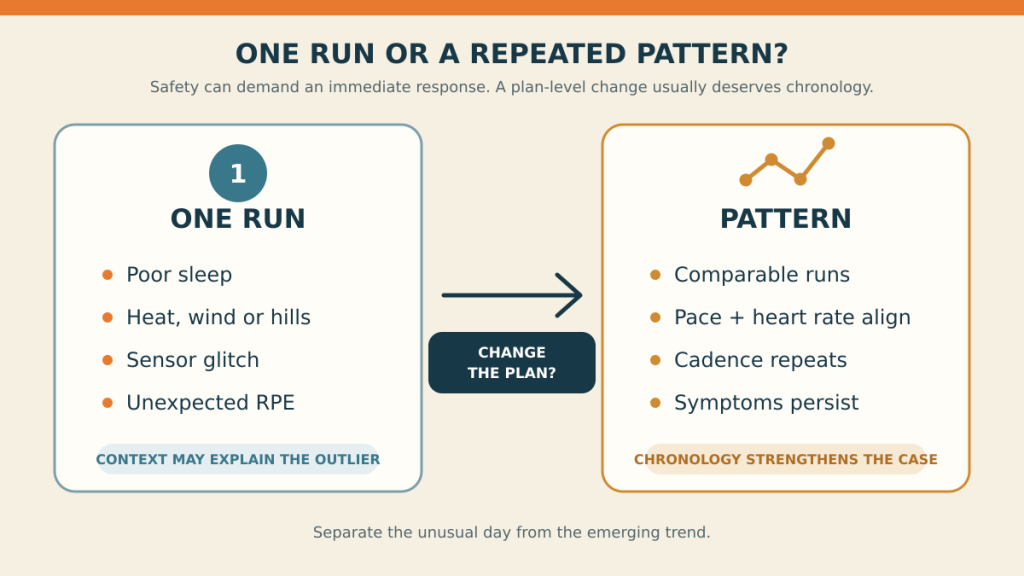
4. Is This One Day or a Pattern?
One run can justify a same-day safety decision. It usually can’t prove a new fitness trend.
A plan-level change deserves chronology. Are several comparable runs becoming harder at the same pace? Is heart rate repeatedly higher under similar conditions? Is the same discomfort returning or worsening? Have multiple workouts been missed? Has life changed enough that the original schedule no longer fits?
This is also why I don’t want CoachChat to treat the latest upload as if no earlier run existed. The last run matters. The sequence matters more.
Five Decisions an AI Coach Can Make
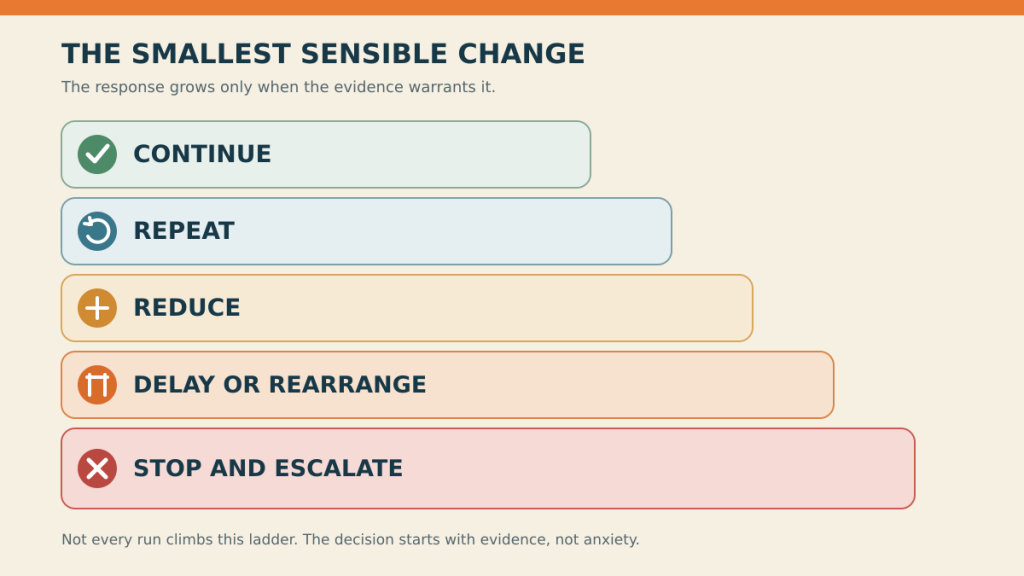
I don’t think every debrief needs a newly invented workout. Most decisions fall into five practical buckets:
- Continue: The workout achieved its purpose and the evidence doesn’t justify a change.
- Repeat: The purpose still fits, but another exposure would be more useful than progressing.
- Reduce: Keep the session type but shorten the duration, lower the intensity or simplify the structure.
- Delay or rearrange: Preserve the useful workout but create more recovery or make it fit real life.
- Stop and escalate: Don’t use AI coaching to diagnose severe, worsening or unusual symptoms. Pause and seek the appropriate qualified professional.
The important part is that the coach names the bucket and explains why. A quietly altered calendar is not the same thing as transparent coaching.
My BlackToe Week 4 Case: No Change Was the Decision
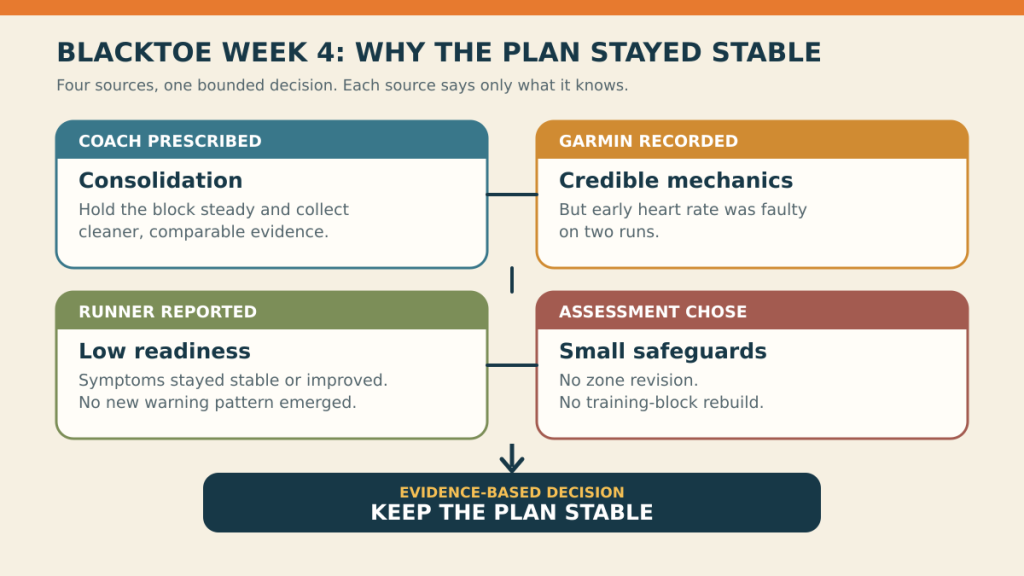
Week 4 of my BlackToe Holiday 10K build was designed to consolidate, not prove. The three runs moved from 35 minutes to 40 and then 45, with RPE and breathing as the primary governors. Heart rate was secondary guidance. Pace was an outcome.
That structure grew from my Ouch to 10K pivot after injury concerns and interrupted training. The job was to rebuild the runner who could train again next week, not chase a flattering graph today.
Low Readiness Didn’t Automatically Cancel the Run
I began Week 4 Run 1 with readiness at 2 out of 5, poor sleep, residual fatigue from helping with a move and general tightness. That sounds like a collection of reasons to change the plan.
CoachChat didn’t ignore them. The run stayed easy, the gradual walk-to-jog transition remained in place and the next session was conditional on ordinary walking, stairs and tightness returning near baseline. But the workout itself achieved its purpose. Heart rate was credible, effort stayed controlled and the tightness improved slightly afterward.
The plan didn’t need a dramatic rewrite. It needed an easy day to remain easy and a sensible check before the next run.
Faulty Heart Rate Didn’t Rewrite My Zones
In Runs 2 and 3, the chest strap produced faulty early heart-rate data. Pace and cadence showed that I was running while the strap reported implausibly low values and then slowly crawled upward.
The useful evidence didn’t disappear. RPE, conversational breathing, pace behaviour, cadence and symptom response still helped us assess the workouts. But those runs couldn’t support a formal aerobic-drift claim or a revision to my heart-rate zones.
My zones were established from my own baseline test rather than an age-predicted formula. Even then, the zones are useful only when the signal itself is credible. A sleepy strap doesn’t get to rewrite the physiology.
Again, no change was the evidence-based choice.
What Would Justify a Bigger Change?
I’d expect CoachChat to consider a larger adjustment when several pieces of credible evidence point in the same direction:
- Repeated failure to complete the intended purpose at the prescribed effort.
- Worsening, recurring or movement-altering pain or other concerning symptoms.
- Several missed sessions or a full interruption that makes the original progression inappropriate.
- A sustained mismatch between the schedule and work, travel, caregiving or recovery needs.
- A repeatable improvement across genuinely comparable runs that supports cautious progression.
- A change in goal race, available training days or the purpose of the block.
The size of the response should match the size of the evidence. One difficult easy run might earn a recovery day or a repeated session. Several compromised weeks might justify rebuilding the block. A medical concern leaves the AI-coaching lane entirely.
Runna’s current plan-realignment guidance makes a similar distinction at the product level: one missed workout can often be skipped or rearranged, while several missed sessions or weeks can trigger a broader rebuild. I like the principle even though my CoachChat process is more conversational and source-by-source.
Why I Want the Reason, Not Just the Replacement Workout
If CoachChat changes Tuesday’s run, I want it to show its work:
- What changed?
- Which evidence justified it?
- Which evidence was rejected or treated cautiously?
- Is this a one-session adjustment or a plan-level change?
- What remains unchanged?
- What should we reassess after the next run?
That explanation protects continuity. It also gives me something to challenge. AI can organize the evidence and propose the next step, but I’m still the runner living inside the consequences.
A published evaluation of ChatGPT-generated running plans found that richer prompts improved the output, yet expert reviewers still didn’t consider the plans optimal. Monitoring, feedback and adjustment remained important gaps. To me, that supports an ongoing evidence loop, not blind faith in a more elaborate opening prompt.
Where the Plus50Fit Tools Could Help
Right now, my Plus50Fit FIT Tool and Run Compare are Python applications on my own computer. The FIT Tool keeps the original prescription beside Garmin’s objective activity evidence and the context the file can’t contain. Run Compare then looks across sessions instead of treating the latest upload as the whole truth.
That longer view could help test whether pace is improving at approximately the same heart rate, whether heart rate is changing at approximately the same pace, how pace, heart rate and cadence relate, and whether two runs are comparable enough to deserve the comparison at all.
The experiment may eventually produce free downloadable Plus50Fit FIT Tools for Windows, with local FIT processing, sample files and a quick-start guide. That’s a possibility, not a promised release. Reader demand, testing, installation, digital signing, privacy, disclaimers, licensing, maintenance and support still need honest answers.
The useful idea doesn’t depend on the software:
Coach prescription → Garmin FIT evidence → runner context → post-run assessment → multi-run trend comparison
A plan should change at the end of that chain, not at the first surprising number.
The Plan Works for the Runner
I genuinely enjoy running. I don’t need every outing to prove fitness, generate a trend or earn a green badge. Some runs are good because I ran them.
I also have enormous fun taking the activity apart afterward. Both things can be true.
The plan is there to help me keep doing this, through the BlackToe Holiday 10K, into my next training block and along the Road to 70. Adaptation matters because life changes. Stability matters because training needs time to work.
I think the best AI coach will know the difference between responding and flinching.
Frequently Asked Questions
Should I change my running plan after one bad run?
Usually, one disappointing run is context rather than a trend. Review the workout purpose, data quality, weather, terrain, sleep, RPE and symptoms before changing the larger plan. A serious or worsening symptom is different and may require stopping and seeking qualified advice.
Can poor sleep justify changing a workout?
Poor sleep can help justify reducing, delaying or replacing one session, especially when it agrees with fatigue, illness, soreness or poor readiness. One sleep score by itself shouldn’t automatically rebuild an entire training block.
What’s the difference between adjusting and rebuilding a plan?
An adjustment changes a workout or a short stretch of training while preserving the block. A rebuild revises the progression from the runner’s current position, often after a longer interruption, repeated missed sessions, a changed goal or evidence that the original assumptions no longer fit.
Can an AI running coach diagnose an injury?
No. AI can help organize symptom history, identify contradictions and suggest that a run be stopped or reduced. It can’t examine the runner, diagnose an injury or replace an appropriate healthcare professional.
How can I ask AI whether my plan should change?
Give it the original workout, what you completed, credible activity data, RPE, breathing, pain or symptoms, sleep, weather, terrain and recent chronology. Ask it to state what changed, what evidence supports the change, what remains stable and when the decision should be reassessed.
AI Disclosure
I developed this article with AI assistance for current research, source checking, structure and drafting. AI is also part of the coaching process being examined. The running experience, opinions, decisions and final editorial judgment are my own.
Safety and Privacy Disclaimer
This article describes my personal N=1 experiment. It isn’t medical advice, diagnosis, rehabilitation guidance or an individualized training prescription. Stop exercise and seek appropriate professional assessment for severe, worsening, unusual or movement-altering symptoms, or whenever you’re concerned about your health.
Activity files can contain routes, locations, timestamps and other personal information. Review what a file contains before sharing it with any AI or online service. My current FIT processing is local on my own computer.