Search for an AI running coach prompt and the internet will quickly offer wording that promises to turn ChatGPT into a coach. Most versions begin with sensible questions about age, goal race, current mileage, available days and injury history. Then the artificial intelligence produces a plan.
I think that is where the interesting part should begin, not end.
A plan is only a proposal. Coaching starts when I try to do the workout, something unexpected happens, and the next decision has to respond to the runner who actually showed up.
In my larger ChatGPT running coach experiment, I connect the original prescription to my Garmin FIT evidence, my own account of the run and CoachChat’s assessment. The prompt below is the practical debrief I want around every session. It is not magic wording. Its job is to make me report enough truth that the answer has a fighting chance of being useful.
A Running Plan Is Only the First Draft
A published study of ChatGPT-generated running plans found that more detailed input improved the plans, but coaching experts still don’t rate even the most detailed versions as optimal. The study also identified missing pieces that sound very familiar in real coaching: monitoring, feedback questions and plan adjustment.
That matters because a six-week plan written on day one can’t know what happens on day four. It can’t know that I slept badly, helped somebody move furniture, ran in heavy humidity, changed shoes, felt a familiar ache or discovered that a supposedly easy pace was not easy that morning.
Even the technology around us is moving toward more personalized interpretation. Garmin Connect+ now includes Active Intelligence, which offers artificial-intelligence-powered insights based on health and activity data. I’m interested in that direction, but more data on a platform doesn’t remove the need for the runner’s own account.
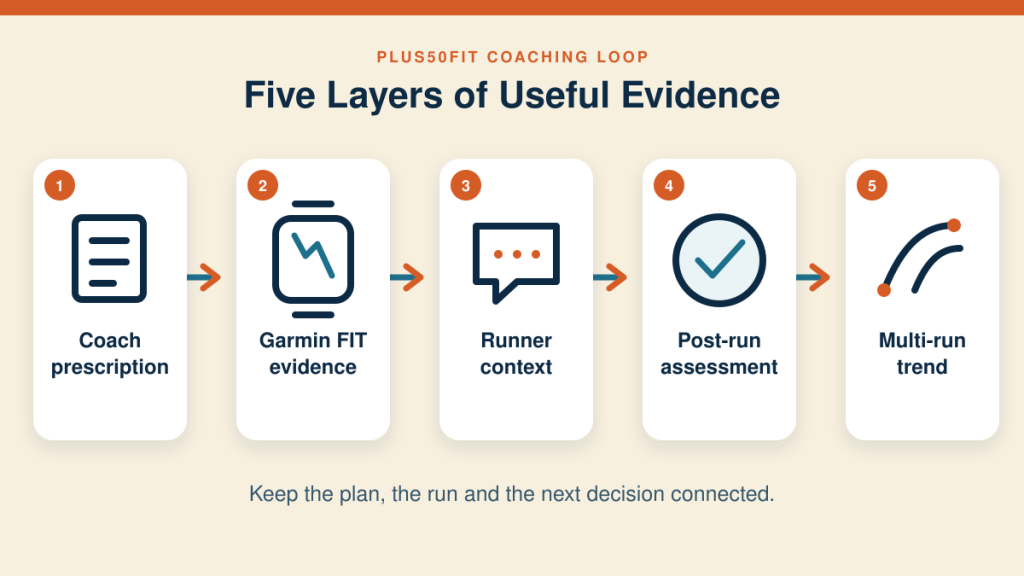
The useful loop is not prompt, plan, obedience.
It’s prescription, attempt, evidence, context, assessment and adjustment.
What My Watch Knows and What It Cannot Know
A Garmin FIT activity file can preserve timestamped sensor and activity records. Depending on the device and session, that may include pace, heart rate, cadence, distance, laps, pauses and events. Garmin’s own FIT documentation describes activity files as containers for sensor data and events recorded during a session.
That’s excellent evidence. It’s not a complete witness statement.
My watch may know that my pace slowed. It doesn’t know whether I was climbing, crossing a road, taking a planned walk, avoiding a puddle or chatting with a running buddy. It can record an odd heart-rate value without knowing that the chest strap had poor contact. It can’t tell whether discomfort felt sharp, familiar, worsening or completely unchanged.
This is why I keep coming back to one sentence:
The data needs the story. The story also needs the data.
My Training Metrics Made Simple guide explains the alphabet soup. My older article about trusting my body more than smart devices explains why the watch should support judgment rather than replace it. This debrief sits between those two ideas. I want the numbers, but I also want the runner who was there.
The Three Layers of My Post-Run Debrief
1. The Prescription
Before looking at the result, I preserve what CoachChat actually assigned:
- Workout ID and name
- Planned duration or distance
- Warm-up, work blocks, recoveries and cooldown
- Target RPE, heart-rate range or pace, where appropriate
- The purpose of the workout
- Any stop, pain or adjustment rules
The purpose is crucial. A 35-minute easy reset should not be judged as a failed time trial because the pace was modest. My current BlackToe Holiday 10K build grew from the earlier Ouch to 10K pivot, so many sessions are deliberately rebuilding consistency rather than proving fitness.
2. The Objective Evidence
Next comes what Garmin recorded and what the FIT Tool calculated:
- Elapsed and moving time
- Distance and pace
- Heart rate, including signal-quality concerns
- Cadence
- Laps, sections, pauses and walk breaks
- Pace and heart-rate behaviour across the session
- Environmental and comparability cautions
- Any metric that should not be calculated from this particular run
I don’t allow a tidy average to hide a messy signal. If the opening heart-rate trace is physiologically implausible, the whole-session average may be mathematically correct and practically misleading. My race-prediction article is a reminder of what happens when an algorithm receives numbers without enough context and answers confidently anyway.
3. The Runner Context
Then I add what the device doesn’t know:
- Overall RPE and section RPE when I can report it honestly
- Sleep duration and quality
- Readiness before the run
- Weather and how it actually felt
- Terrain and surface
- Footwear
- Fuel and hydration
- Pain or soreness before, during and after
- Breathing and talk-test observations
- Walks, stops, route changes or social running
- Strength training or unusual activity that may affect the session
- What felt smooth, awkward, surprising or different
- Questions I want CoachChat to answer
This is the part that keeps the runner in the system.
A Real BlackToe Example: The FIT File Was Not Enough
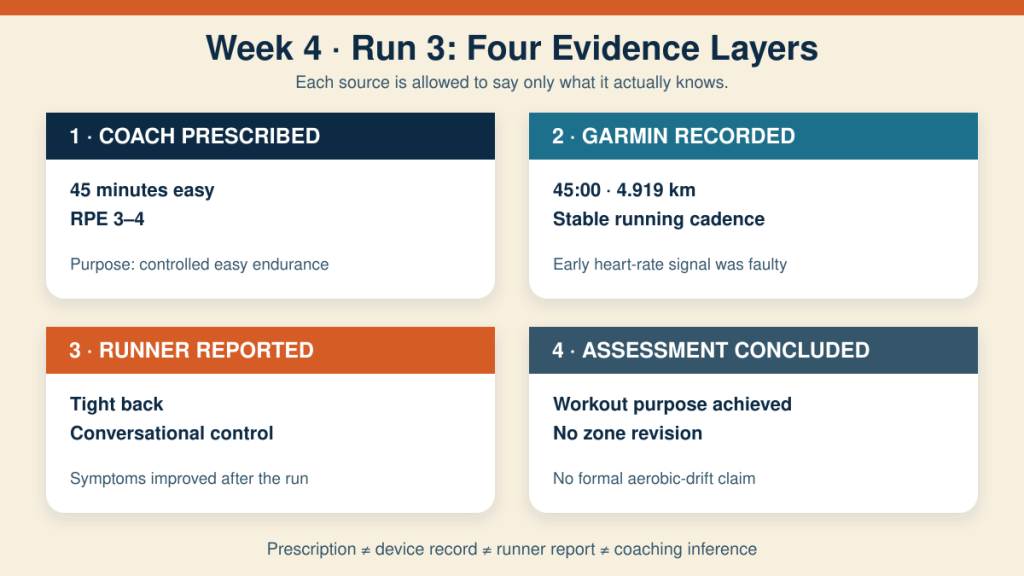
Week 4 Run 3 was a 45-minute Easy Endurance session. CoachChat prescribed a five-minute brisk walk, 35 minutes of easy running at RPE 3 to 4 and a five-minute cooldown walk. Heart rate was secondary guidance, with most running intended to remain in the provisional Zone 2 range.
Garmin recorded 45:00 and 4.9 kilometres. Once I was running, cadence was generally stable around 159 to 164 steps per minute. The early heart-rate trace, however, was not credible. Pace and cadence showed normal running while the strap reported heart rate in the 50s and then slowly crawled upward.
If I had supplied only the summary numbers, an AI could have treated the 125 beats-per-minute average as evidence of a wonderfully low aerobic cost. That would have been nonsense.
My debrief explained that the mid-back was tight, breathing felt shallower at first, I divided the running into the intended 10/10/10/5-minute sections, and I could still talk comfortably while running with a friend. The discomfort stayed at 3/10 during the run and improved to 2/10 afterward. Overall RPE matched the prescribed 3 to 4.
CoachChat’s assessment could then separate the evidence properly:
- Coach prescribed easy endurance.
- Garmin recorded the complete duration, pace, cadence, interruptions and a faulty early heart-rate signal.
- I reported the breathing, conversation, back tightness, symptom response and intended structure.
- The FIT Tool organized the objective and subjective records.
- CoachChat inferred that the workout purpose was achieved, while refusing to use the session to revise my heart-rate zones or calculate formal aerobic drift.
That distinction is the whole game. The assessment didn’t declare the FIT file useless. It used the credible parts and rejected the parts that couldn’t support the conclusion.
The same principle appears in my Blue Nose 10K debrief. Official results, Garmin activity evidence and my own race account each answered a different question. None deserved to swallow the others.
My Copyable AI Running Coach Prompt
This is the reusable prompt I would give an AI after a run. I would paste the specific prescription, activity summary and runner context beneath it.
COPYABLE PROMPT START
Act as a cautious running-coach assistant reviewing one completed workout within an ongoing training block.
Separate the evidence into five clearly labelled sources:
1. What the coach prescribed.
2. What the watch or activity file recorded.
3. What the analysis tool calculated.
4. What the runner reported.
5. What you infer from those sources.
Do not invent missing data. Do not treat a device reading as valid merely because it is numeric. Flag contradictions, implausible sensor values, pauses, terrain, heat, illness, poor sleep, pain and any factor that limits comparison with other runs.
First determine whether the workout achieved its assigned purpose. Do not judge an easy, recovery or return-to-running session by speed alone.
Then provide:
1. A concise session headline.
2. Planned versus completed structure.
3. The most credible evidence.
4. Questionable or unusable evidence.
5. RPE, breathing, symptom and recovery interpretation.
6. What can reasonably be concluded.
7. What should not be concluded.
8. The next-session implication, including whether to proceed, reduce, delay or seek qualified professional advice.
Do not diagnose pain or injury. If symptoms are severe, worsening, unusual, affect gait or breathing, or raise medical concern, say that an appropriate healthcare professional should assess them.
Preserve uncertainty. If the evidence does not justify changing heart-rate zones, training paces or the plan, say so.
Workout prescription:
[PASTE THE ORIGINAL WORKOUT]
Watch or FIT evidence:
[PASTE THE ACTIVITY SUMMARY OR ATTACH THE FILE]
Runner context and debrief:
[PASTE THE POST-RUN NOTES]
Questions for CoachChat:
[PASTE THE QUESTIONS]
COPYABLE PROMPT END
The prompt is deliberately less glamorous than “make me faster.” It asks the AI to show its work, preserve uncertainty and state what the run cannot prove.
My Quick Post-Run Checklist
When I don’t want to write a miniature autobiography on the sidewalk, this is the short version:
- Run ID and assigned purpose
- What I completed, skipped or changed
- Overall RPE from 1 to 10
- Breathing or talk-test description
- Pain or soreness before, during and after
- Sleep and readiness
- Weather, terrain and footwear
- Fuel, hydration, walks and unusual stops
- One thing that felt good
- One thing that concerned or surprised me
- One question for the coach
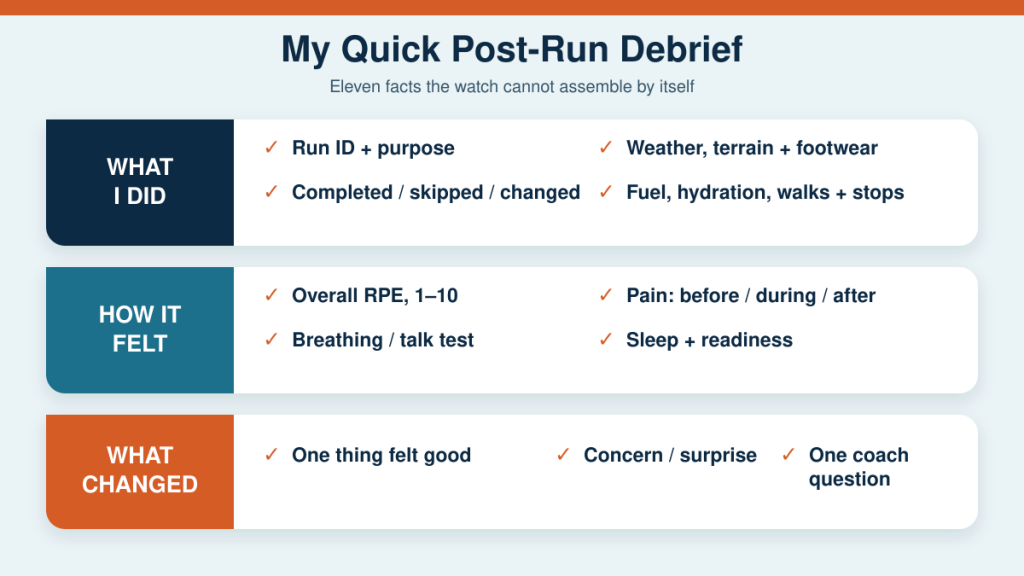
I try to record the subjective pieces before staring at every graph. Otherwise the data can rewrite my memory of the run. A red number can make a perfectly enjoyable outing feel retroactively poor, while a flattering average can make me forget that something felt wrong.
What I Ask CoachChat to Answer
A useful assessment should answer more than “good job”:
- Did the session achieve its assigned purpose?
- Which data are credible enough to interpret?
- Which data are compromised, and why?
- Did pace, heart rate, cadence, breathing and RPE broadly agree?
- How did pain or soreness change from before to after?
- Is this run comparable with earlier sessions?
- What should not be inferred from it?
- Does the next workout stay, change, move or disappear?
- What should trigger medical, physiotherapy or coaching input?
I also want the answer to preserve chronology. The next prescription should know what happened last week, not react dramatically to the latest graph as if no earlier run existed.
How Much Data Is Enough?
A runner doesn’t need my entire setup to improve an AI conversation.
The minimum useful package is the planned workout, what was completed, overall RPE, any pain or unusual symptom, and enough context to explain obvious disruptions. Add a Garmin or Strava summary if that is what you have. Screenshots can be useful, although they may hide pauses, sampling problems and the exact timing of changes.
A raw FIT file offers more detail. Garmin’s FIT protocol can preserve sensor and event records beneath the summary screen. My Plus50Fit FIT Tool processes that file and combines it with the prescription and my debrief. Plus50Fit Run Compare then reads the resulting run folders and looks across sessions rather than pretending one morning establishes a trend.
More data are not automatically better. The right question is whether each field helps the coach understand the workout, compare it fairly or make the next decision.
Why This Needs Extra Care After 50
Running after 50 is not one condition. Two runners of the same age can have completely different histories, health considerations, medications, training backgrounds and goals.
Generic age-predicted heart-rate formulas are estimates, not personal laboratory results. The American Heart Association describes target figures as averages and notes that some medications can affect heart rate. My heart-rate zones were established from my own baseline test rather than an age-predicted formula. Even then, those zones are useful only when the heart-rate signal itself is credible.
The debrief should therefore include relevant health and medication context when it affects training, without asking AI to practise medicine. Pain, dizziness, chest discomfort, unusual shortness of breath or other concerning symptoms are not prompt-engineering puzzles. They deserve appropriate professional attention.
I think good AI use begins with knowing which questions should leave the chat.
The Data Is a Second Layer, Not the Run
I genuinely enjoy running. I don’t want every outing to become a laboratory session with me as both the rat and the clipboard.
I also have great fun drilling into the data afterward. Apparently I have become a late-blooming running-data nerd. I can spend an unreasonable amount of time asking why pace improved at a similar heart rate or whether cadence held together late in a run.
Both things can be true.
I haven’t run with my Shokz, bone conduction headphones or phone in months. I expect the phone will return as the runs get longer, especially for safety and practical reasons, but lately I have enjoyed hearing the run itself. Footsteps, breathing, traffic, birds, the occasional muttered negotiation with an incline.
The debrief doesn’t exist to decide whether the run was worthwhile. It adds a fascinating second layer. A joyful run remains joyful even if the sensor sulked. A hard run is not redeemed by a green badge. The numbers help me ask better questions after I’ve lived the experience.
Where the Plus50Fit Experiment May Lead
My current tools are Python applications on my own computer. The FIT Tool connects the CoachChat prescription to Garmin FIT metrics and my run context. The Run Compare app examines multiple sessions using pace at approximately the same heart rate, heart rate at approximately the same pace, pace-heart-rate-cadence relationships, aerobic efficiency, workout-section comparisons and environmental cautions.
The experiment may eventually produce free downloadable Plus50Fit FIT Tools for Windows, with local FIT processing, sample files and a quick-start guide. That is a possibility, not a public release promise.
Before that could happen, the tools would need testing beyond my computer, clearer installation guidance, decisions about digital signing, privacy and medical disclaimers, licensing, maintenance and support. Mac support is unresolved.
For now, the useful idea doesn’t require software:
Coach prescription → Garmin FIT evidence → runner context → post-run assessment → multi-run trend comparison
Any runner can begin with the first four parts using a simple note.
The Better Prompt Is an Honest Debrief
The best AI running coach prompt is not a spell that turns ChatGPT into an infallible coach. It’s a structure that makes the runner provide the information a polished answer might otherwise pretend it already knows.
I want CoachChat to know what it assigned, what Garmin recorded, what I experienced, what the tools calculated and where the evidence breaks down.
Then I want it to make the smallest sensible next decision.
That is less exciting than generating a complete race plan in thirty seconds. It is also much closer to the reason I began this experiment: not to hand my running over to artificial intelligence, but to build a better conversation around the running I am already doing.
Frequently Asked Questions
What should I tell ChatGPT after a run?
Provide the original workout, what you completed, RPE, pain or symptoms, breathing, sleep, weather, terrain, footwear, unusual stops and the activity data you have. Ask it to separate recorded facts from your report and from its own inference.
Can ChatGPT analyze a Garmin FIT file?
Capabilities vary by product and session. A FIT file can contain detailed activity and sensor records, but an AI may need the file decoded or exported into readable tables. Review privacy-sensitive details such as routes, timestamps and locations before sharing.
Is RPE useful if I have heart-rate data?
Yes. Heart rate and RPE answer related but different questions. RPE captures how hard the effort felt, while heart rate is one physiological response. A small 2025 study in trained young men found acceptable repeatability for thresholds derived from both, with tighter error bands for heart rate. That population does not represent every older runner, but it supports treating RPE as useful evidence rather than decorative commentary.
Should an AI running coach change my plan after every run?
Not automatically. Sometimes the correct response is no change. A single unusual run may be explained by heat, sleep, terrain, sensor error or ordinary day-to-day variation. Changes should match the strength of the evidence and the seriousness of any symptom.
Can this prompt replace a human running coach or healthcare professional?
No. It can organize evidence, expose gaps and support questions. It cannot examine you, observe your movement directly, diagnose injury or provide the judgment and accountability of an experienced professional who knows you.
AI Disclosure
I developed this article with AI assistance for research, source checking, structure and drafting. AI is also part of the subject being tested. The running experience, opinions and decisions are my own. I will review and revise the article before publication.
Safety and Privacy Disclaimer
This article describes my personal N=1 experiment. It is not medical advice, diagnosis, rehabilitation guidance or an individualized training prescription. Consult an appropriate healthcare or qualified exercise professional before beginning or changing training, especially if you have pain, injury, cardiovascular concerns, chronic conditions or medication-related questions.
Activity files can contain routes, locations, timestamps and other personal information. Upload only files you are entitled to use and review what they contain before sharing them with any service.