If you;ve read more than one of my recent running articles, you may have noticed that I keep reporting the same slightly odd detail: I could still breathe through my nose.
There’s a practical reason. I do most of my running alone. The usual conversational-pace test assumes another person is there to hear the conversation, and talking to myself for forty-five minutes might create an entirely different kind of training data.
Nose breathing gives me a simple, immediate effort check. If it feels relaxed and sustainable during an easy run, that tells me something useful. If the urge to forcefully exhale and open my mouth becomes urgent, that tells me something too.
It doesn’t tell me my exact heart-rate zone, prove that a run was aerobic or turn nasal breathing into the One True Way to Run. I use it as one clue among RPE, heart rate, pace, symptoms, terrain, weather and what the workout was supposed to accomplish.
Where I Got the Idea
I picked up the basic nose-breathing cue from RunnersConnect. Their breathing guidance made me pay attention to whether an easy effort remained comfortable before I became completely absorbed by the number on my watch.
The idea clicked because the standard talk test is useful enough. A review of the talk-test research found that comfortable speech generally occurs below the ventilatory or lactate threshold, while speech becomes difficult above it. Another review of subjective intensity methods concluded that the talk test and RPE can be practical tools for identifying exercise-intensity domains.
I’m not claiming that breathing only through my nose is the same test. The talk test asks whether speech remains comfortable. My nose-breathing check asks whether my breathing still feels controlled through a deliberately narrower route.
My First Nose-Breathing Experiment
This didn’t begin with CoachChat. In April 2025, I wrote Are My Heart Rate Zones Wrong? A Nose-Breathing Experiment after a 120-minute treadmill run.
My heart-rate data said I had spent long stretches above Zone 2. My breathing, effort and recovery told me something else. I could breathe through my nose for the full run and felt strong from beginning to end.
At the time, I wondered whether my heart-rate zones were wrong, whether the run showed better aerobic efficiency, whether normal cardiac drift had raised the number or whether nasal breathing was simply an imperfect clue.
The honest answer was that one run couldn’t settle the matter. That older post captured the question. My current BlackToe experiment has given the question a better system.
I now preserve the original workout, Garmin metrics, my RPE, breathing, readiness, symptoms and what happened next. Nose breathing no longer has to defeat heart rate in a courtroom drama. The two can agree, disagree or remain uncertain while the rest of the evidence helps CoachChat decide what the run actually supports.
The Personal NBr Scale I Use With CoachChat
In my debriefs, I shorten nose breathing to NBr and give it a score from 1 to 5. This is my own working scale. I haven’t found it in the research or in RunnersConnect’s material, and I don’t present it as a validated measurement.
| NBr | What I mean |
| 1 | Completely relaxed. Nose breathing is so easy that I can forget I am monitoring it. |
| 2 | Easy and steady. Breathing is noticeable but natural, with no real urge to open my mouth. |
| 3 | Controlled work. I can maintain nasal breathing, but I am aware that effort has risen. |
| 4 | Strained. The urge to exhale harder or switch to mouth breathing is building. |
| 5 | I desperately want to exhale forcefully and mouth-breathe. |
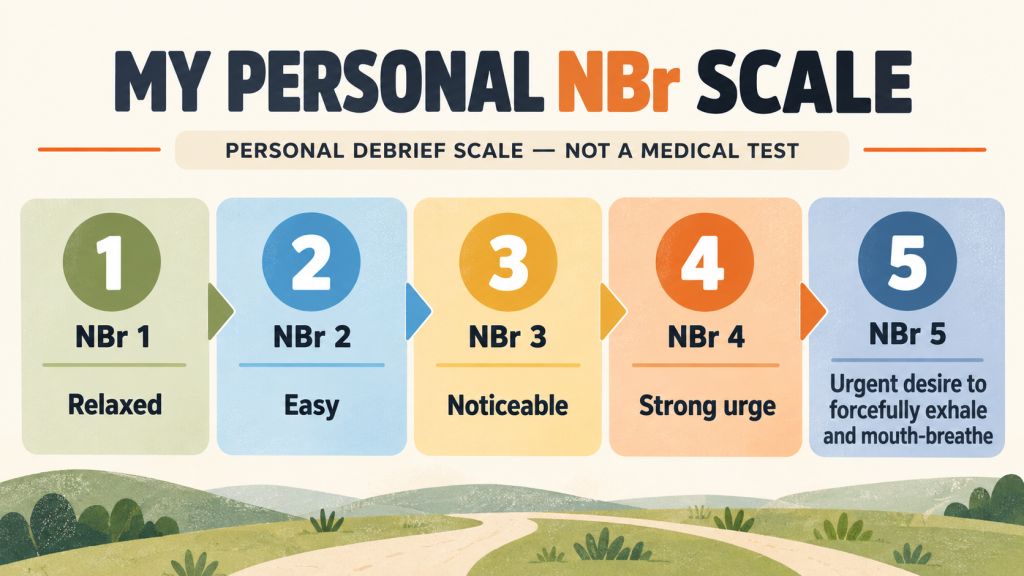
not a validated physiological test.
NBr 5 doesn’t mean danger by itself. It means nasal-only breathing has reached the point where I strongly want more ventilation. On a hard interval or at the end of a race, mouth breathing is normal. On a run prescribed at RPE 3 to 4, the same score would make me ask why the effort has climbed.
I care more about the direction than the absolute score. A run that moves from NBr 1 or 2 to 4 at unchanged pace deserves attention. A brief rise on a hill may be perfectly sensible. A score that stays easy while a chest strap reports nonsense is useful supporting evidence, not permission to ignore every other signal.
What Nose Breathing Can Tell Me
It can expose effort drift before pace makes sense of it
Pace changes immediately with hills, wind, surface and heat. Breathing can tell me that the same pace is costing more today, or that a deliberately slower pace is keeping the intended effort under control.
That is especially useful during my BlackToe rebuild. The goal is timed growth, not burnout that defeats the long-term race goal.
It can support RPE when heart-rate data misbehaves
I’ve had chest-strap readings that were clearly questionable, including implausibly low values early in a run. The Garmin FIT file preserves exactly what the sensor recorded, including bad evidence.
When heart rate is suspect, my breathing report and RPE help describe the actual effort. They don’t repair the broken trace. They stop the broken trace from owning the entire assessment.
It can make an easy-run prescription more usable
CoachChat can prescribe RPE 3 to 4, with heart-rate as a backup and controlled breathing. I can then report whether those signals broadly agreed.
My heart-rate zones for runners over 50 are provisional for exactly this reason. A heart-rate boundary looks exact on a screen, but readiness, heat, hills, medication, fatigue and sensor quality can change what the number means on a particular day.
What Nose Breathing Can’t Tell Me
Nose breathing is not my personal lactate analyser.
It can’t prove that I am in Zone 2. It can’t diagnose a breathing problem, establish my aerobic threshold or guarantee that the workout load was appropriate. Nasal anatomy, congestion, allergies, temperature, humidity, pace and familiarity with the technique can all change how it feels.
A small 2018 study found that recreational runners who had already adapted to nasal breathing could complete maximal testing without losing VO2max or time to exhaustion, while showing different ventilatory responses. That does not prove a universal performance benefit. A larger 2025 PLOS One study found that exclusive nasal breathing limited peak exercise capacity in healthy participants because ventilation could not rise enough.
That result kind of makes sense to me. When the work becomes hard, the body wants more air. I definitely not going to turn a useful easy-run cue into a rule that says I must keep my mouth closed during intervals, hills or a finishing kick.
I also won’t use a comfortable NBr score to override unusual breathlessness, chest pain, dizziness or another concerning symptom. A number I invented for debriefs doesn’t override common sense or appropriate medical care.
How It Fits Beside Pace, Heart Rate and RPE
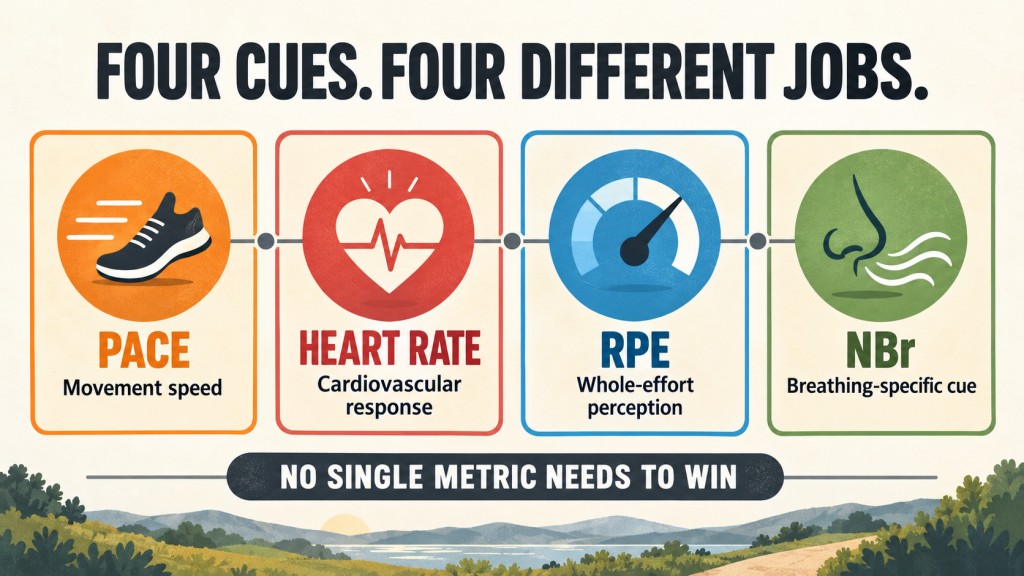
Each measure gets a different job.
- Pace tells me how quickly I am moving and matters directly in pace-specific workouts.
- Heart rate shows cardiovascular response when the signal is credible, but it can lag and react to heat, hills, fatigue, stress and medication.
- RPE tells me how hard the whole effort feels, including information the watch can’t measure.
- NBr gives me a breathing-specific cue that’s easy to monitor when I am alone.
During an easy run, RPE and breathing can govern my effort while heart rate and pace provide useful context. During pace-specific intervals, I can execute the intended pace, use feel as an immediate guardrail and examine heart rate afterward, including where I felt as if I was blowing up.
My AI running coach experiment becomes more useful when I report the disagreements. If pace was slow, heart rate was high, NBr was 4 and RPE was 6, the run was not secretly easy because one metric looked flattering. If the chest strap reported an impossible number while pace, cadence, RPE and NBr remained stable, CoachChat can reject the bad signal without rejecting the run.
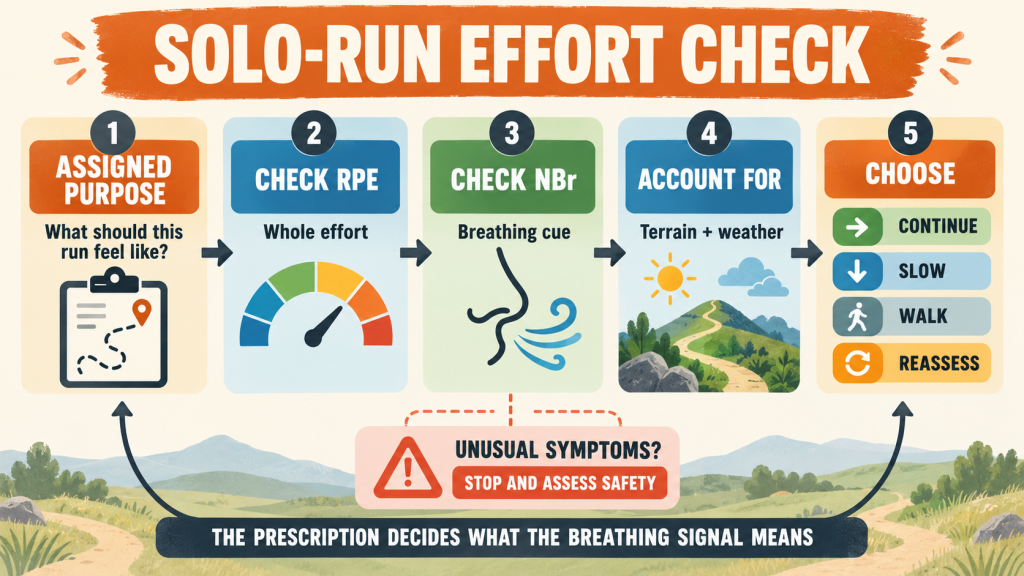
A Simple Solo-Run Check
I don’t perform a formal test every few minutes. I check in when the terrain changes, when effort seems to drift or when the workout has a controlled section that should remain easy.
- What is the assigned purpose of this run?
- What is my current RPE?
- Can I breathe comfortably through my nose without forcing it?
- Has the NBr score changed at the same pace, or did a hill, wind or heat explain it?
- Do pain, mechanics, dizziness or unusual breathlessness change the decision?
Easy running and hard intervals should not feel the same.
If the run is meant to be easy and NBr moves toward 4 or 5, I can slow down, walk briefly or reassess. If I’am completing an interval, I expect breathing to change. The prescription decides whether the signal is a problem.
My post-run debrief prompt then records the score beside RPE, symptoms, weather, terrain and the credible device evidence. Detailed communication before, during and after the run is what gives CoachChat a chance to make a sensible next decision.
Why I Will Keep Reporting It
I like running without turning every step into an exam. Nose breathing works for me because the check is available without stopping, pressing a button or waiting for a graph.
It also keeps the human part of the run inside a data-heavy experiment. Garmin can record heart rate and pace to the second. It can’t know that my breathing felt relaxed, that a hill briefly pushed the effort up or that I desperately wanted to forcefully exhale before the watch admitted anything had changed.
At 68, I am trying to become more consistent, not more obedient to a single metric. NBr gives me another way to notice what my body is doing while the run is still happening.
I think that is why I keep talking about it. Nose breathing is not the boss of me, or the run. It’s just along for the ride..er, run.
Frequently Asked Questions
Is nose breathing while running proof that I am in Zone 2?
No. Comfortable nasal breathing may support the impression that effort is controlled, but it does not identify an exact physiological zone. Use it beside RPE, heart rate when reliable, terrain, weather and the purpose of the workout.
Should I breathe only through my nose on every run?
I do not. Nasal-only breathing is a cue I use mainly during easy running. Harder efforts naturally require more ventilation, and forcing nasal breathing can limit performance or make the effort unnecessarily uncomfortable.
Is your NBr 1 to 5 scale scientifically validated?
No. It is my personal debrief scale. Its value is consistency in my own notes, especially the NBr 5 anchor. It should not be treated as a clinical or universal scale.
Why not use the talk test when running alone?
The talk test remains useful, and I can say a sentence aloud if I need to. Nose breathing is simply less awkward and easier for me to monitor continuously when no running partner is present.
What if nose breathing is difficult even at an easy pace?
Congestion, allergies, nasal anatomy, illness and other factors can make it difficult. Do not force it or use someone else’s breathing pattern as a verdict on your fitness. New, unusual or worsening breathing difficulty deserves appropriate clinical attention.
AI disclosure: I use ChatGPT as part of this N=1 running-coach experiment to help organize prescriptions, Garmin-derived evidence, my reports, research and draft analysis. I review the conclusions and remain responsible for my training decisions and the final published wording.
Safety disclaimer: This article documents my experience as a recreational runner and is not medical advice, diagnosis or a substitute for individualized coaching or clinical care. Do not force nasal-only breathing through significant discomfort. Stop or modify exercise and seek appropriate help for chest pain, faintness, severe or unusual breathlessness, or symptoms that are new, worsening or movement-altering.