One of the most satisfying signs in running data is also one of the easiest to oversell: I run faster at the same heart rate.
Sounds simple, right? Same cardiovascular cost, more speed. I must be getting fitter.
Sometimes, I think that is exactly what the data is telling me. Sometimes the weather is cooler, the route is flatter, the heart-rate strap has finally decided to behave, or I’ve compared the smooth middle of one run with the walk-filled average of another. The arithmetic can be correct but delivers a wonky conclusion.
At 68, I have become a late-blooming running-data nerd. I genuinely enjoy opening the file after a run and seeing what happened underneath the summary. But I do not live or die by the numbers. The data is a fascinating second layer of running, not the reason I run and not a referee deciding whether the morning was worthwhile.
So this is the question I am now asking during my BlackToe Holiday 10K experiment: when does pace at the same heart rate provide useful evidence of progress, and when am I comparing two runs that only look similar from a distance?
Why Runners Keep Asking This Question
Current running advice often points to two related signs of aerobic progress: a faster pace at roughly the same heart rate, or a lower heart rate at roughly the same pace. A recent Runner’s World comparison of pace, heart rate and perceived effort makes the sensible point that each measure answers a different question and each can be distorted by conditions.
The search intent is understandable. Race times arrive occasionally. Easy runs arrive several times a week. If ordinary training can show that the aerobic engine is becoming more capable, I don’t have to wait for a race or time trial to learn whether the work is doing anything.
The idea also appears in newer running products and analysis systems. Some track speed-to-heart-rate relationships over time. TrainingPeaks’ updated explanation of aerobic decoupling examines whether output and heart rate remain coupled within a steady endurance session. A 2025 preprint on heart-rate efficiency in amateur runners proposes a combined pace and heart-rate measure for longer-term tracking. I find the direction interesting, but a preprint and a useful metric are not the same thing as a verdict on one run.
What Pace at the Same Heart Rate Is Actually Asking
Faster Pace at a Similar Heart Rate
If I compare two genuinely similar steady runs and the later one is faster at about the same heart rate and effort, that can be evidence that I am producing more external work for a similar internal cardiovascular response. It may reflect improved aerobic fitness, running economy, freshness, or a combination of factors.
The careful words are “genuinely similar.” I’m not looking for two whole-run averages that happen to share a number, but I am looking for comparable sections performed for the same purpose, at a similar stage of the run, with credible sensor data and reasonably similar conditions.
Lower Heart Rate at a Similar Pace
The comparison works in the other direction too. If I can hold about the same pace with a lower heart rate, similar breathing and similar RPE, that may suggest the same speed is costing less.
But heart rate is not a fixed speedometer. Heat, hydration, fatigue, stress, medication, hills, wind, sensor contact and normal day-to-day variation can move it. Research on cardiovascular drift during heat stress explains why heart rate can rise during prolonged moderate exercise, especially in the heat, even when pace does not. That does not make heart rate useless. It means the number needs company.
My Six Rules for Comparing Runs
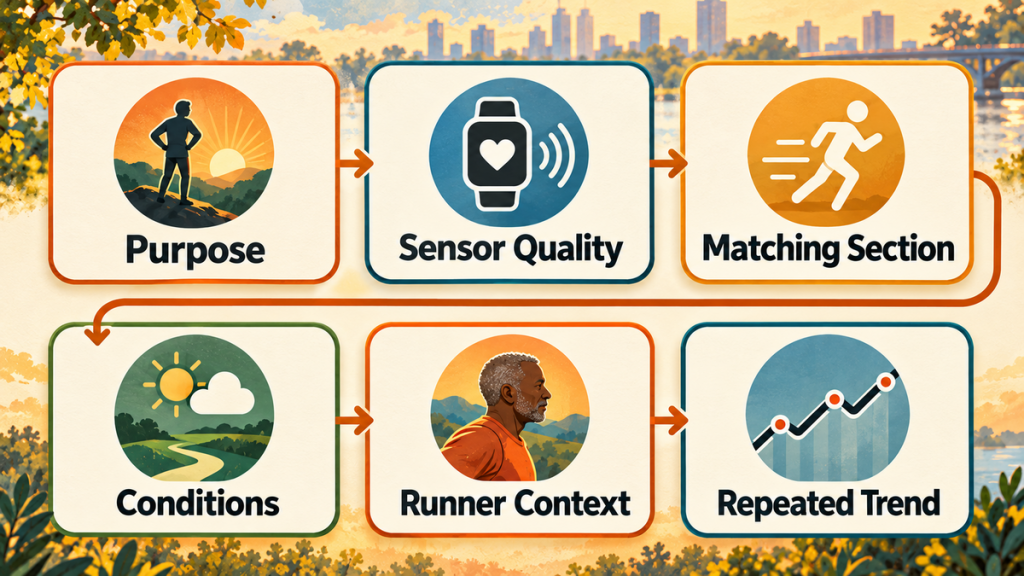
1. Compare the Workout Purpose First
An easy endurance run, a progression run and a recovery jog may all contain kilometres at the same pace. They’re not the same workout.
My AI coach has to begin with the prescription: what was I asked to do, at what effort, and for what purpose? If Tuesday was controlled aerobic running and Sunday was simply about accumulating easy time, a pace difference doesn’t automatically rank one run above the other.
This is why the first step in my AI running coach experiment is the Coach prescription, not the Garmin summary. The run has to be judged against its own job before it is compared with another run.
2. Reject Bad Sensor Data Before Doing Good Mathematics
A heart-rate average can be calculated perfectly from a bad trace.
During BlackToe Week 4, my chest strap reported wonkly low values while pace and cadence clearly showed that I was running. It then climbed, lost connection and only later settled into something believable. My Garmin FIT file article explains how the timestamped record can reveal those dropouts and spikes instead of hiding them inside a tidy session average.
Studies comparing consumer heart-rate monitors with reference measurements show that accuracy varies by device and exercise intensity. One treadmill study of four wrist-worn monitors found meaningful differences as speed increased. My own problem was a chest strap connection, not that specific wrist-watch test, but the broader lesson holds: inspect the signal before treating it as physiology.
Garmin’s FIT protocol documentation describes the messages used to store activity data. The file preserves what the device received. It cannot guarantee that the sensor was telling the truth.
3. Compare the Right Sections, Not Just the Whole-Run Average
My warm-up walk, steady running, traffic stop, incline walk and cooldown can all land in the same average. That average answers, “What happened across the entire recording?” It may not answer, “How efficiently did I run during the intended aerobic block?”
For a clean comparison, I want matching sections. That might mean the middle 15 minutes of two controlled aerobic runs, or kilometre splits after both runs have settled. I exclude warm-up, cooldown, obvious stops and invalid sensor periods when the question requires it.
This doesn’t mean deleting inconvenient data. The excluded minutes stay visible, along with the reason they were excluded. Transparency matters more than making the graph look persuasive.
4. Account for Conditions and Terrain
Same heart rate on a cool morning on a flat route, is not automatically equivalent to the same heart rate on a warm, humid, rolling route. Wind, surface, hills and accumulated heat can all change the pace produced at a given effort.
I do not need laboratory perfection. I need enough similarity to make the comparison honest, plus visible cautions when conditions differ.
5. Keep RPE, Breathing and Cadence Beside the Numbers
Heart rate and pace can agree while my context tells a different story. A lower heart rate may arrive with tired legs and altered mechanics. A faster pace may come from pushing harder, even if the average heart rate looks familiar because of lag or a brief comparison window.
My post-run debrief adds RPE, breathing, sleep, readiness, pain, terrain, footwear and observations. Cadence can provide another check on whether the running rhythm stayed recognizable, although it’s not a score to chase.
I’m looking for convergence. Faster at similar heart rate, similar RPE, ordinary breathing, stable mechanics and no concerning symptom response is more persuasive than one flattering pace number.
6. Look for a Trend, Not a Trophy Run
One run can be encouraging. Several comparable runs can begin to form evidence.
That’s a different standard from a same-day safety decision. If pain worsens or my gait changes, I don’t need a six-run trend before stopping. But if I want to claim that fitness improved, I would rather see the relationship repeat across a training block.
My smallest-sensible-change rule applies here too. I don’t want to see one fast easy run trigger a new pace target any more than I want one slow run to persuade coach that fitness has vanished.
BlackToe Week 4: Two Successful Runs and No Clean Comparison
Week 4 gives me a useful example because the headline numbers make for good comparison.
Run 2 was a 40-minute aerobic-control session. The whole recording averaged 9:05 per kilometre, including walking, with a reported average heart rate of 131. Run 3 was a 45-minute easy-endurance session. The whole recording averaged 9:09 per kilometre, including walking and interruptions, with a reported average heart rate of 125.
If I stopped there, I could tell myself almost any story. The longer run was only four seconds per kilometre slower at a heart rate six beats lower. Progress! Or the second run was slower. Decline!
Neither story survives inspection.
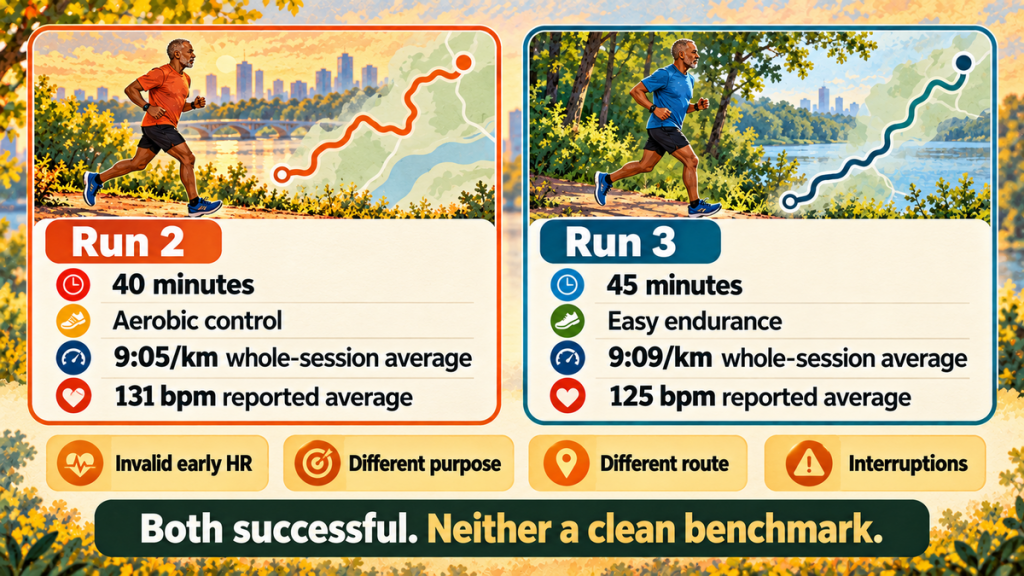
Run 2 was flat, with 91 percent humidity, and its early heart-rate trace was faulty. Run 3 used a gently rolling route, included brief interruptions and social running, and again had invalid early heart-rate data. The sessions had different durations and different purposes. I also began Run 3 with lower readiness and a tight mid-back that affected my breathing before improving after the run.
The credible conclusions were more modest and more useful: both workouts achieved their assigned purpose, overall RPE remained 3 to 4, conversational or controlled breathing supported the intensity judgment, running cadence stayed stable once moving, and the back symptom did not worsen. Neither run was suitable for changing my heart-rate zones or claiming formal aerobic drift. Neither was a clean pace-at-heart-rate benchmark.
That is not a failure of the data. It’s good analysis refusing to manufacture certainty.
My article on what Strava missed about one of these runs reaches the same lesson from a different direction: a polished summary can be accurate about the activity it sees and still miss the prescription, the faulty sensor and the runner’s own report.
What AI Adds, and What It Still Cannot Decide for Me
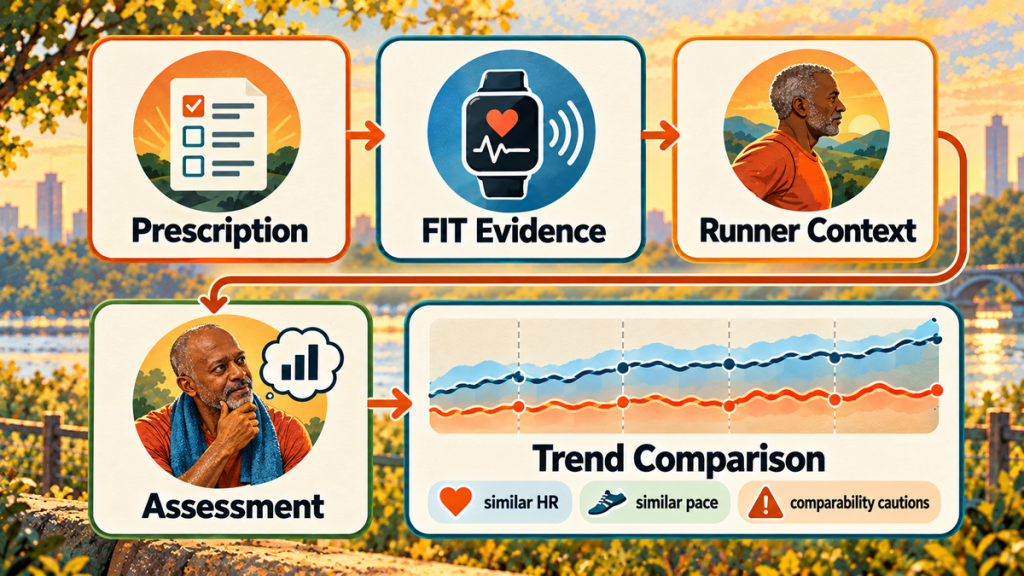
AI is useful here because comparison is fussy. It can line up the prescription, activity sections, pace, heart rate, cadence, weather and my notes. It can identify mismatched durations, mark sensor-quality warnings and ask whether two runs are comparable enough for the question I am asking.
It can also show its work. I want the assessment to say which sections were compared, which were excluded, what conditions differed and why the conclusion is strong, weak or unavailable.
What I don’t want is an AI coach converting every pair of runs into a score. False precision is still false.
The larger transparent chain remains:
Coach prescription -> Garmin FIT evidence -> runner context -> post-run assessment -> multi-run trend comparison
My training metrics guide for runners over 50 explains the individual numbers. Then through comparison we can ask: do these numbers belong beside each other?
What Would Convince Me That Fitness Is Improving?
I would become more confident when several comparable sessions show some combination of:
- A faster pace at approximately the same credible heart rate and similar RPE.
- A lower heart rate at approximately the same pace under similar conditions.
- More running time at the assigned easy effort without mechanical or symptom deterioration.
- Less late-run cost, with pace, heart rate and cadence remaining more stable across the useful sections.
- The same work feeling easier, with calmer breathing and better recovery afterward.
- The pattern repeating across multiple runs rather than appearing once.
None of those guarantees a faster 10K. Race performance also depends on specific endurance, speed, pacing, health, recovery, course and conditions. I’m tracking an aerobic trend, not trying to compress the whole runner into one efficiency number.
The BlackToe race will eventually provide its own answer. Training data help me decide whether the work is moving in a promising direction and whether the next step is sensible.
I Still Want to Run the Run
I could spend so much time comparing pace and heart rate that I forget why I started running.
I haven’t run with my Shokz or phone in months. That was not a data experiment. I simply enjoyed heading out with less stuff. I expect the phone will return as the runs become longer, mostly for practical safety and contact, and the Shokz may come along too.
The watch will keep recording. I’ll keep poking around in the files because I find the evidence genuinely entertaining. But some runs are worthwhile because the weather felt good, the legs found a turnover rhythm, a conversation carried me along, or I finished more cheerful than I started.
Pace at the same heart rate can help answer whether my aerobic running is changing. It can’t tell me whether I loved the morning.
I think the best use of data is to make the coaching more honest while leaving the running fully human.
Frequently Asked Questions
Does a faster pace at the same heart rate mean I am fitter?
It can be a useful sign of improved aerobic fitness or efficiency when the runs have the same purpose, the heart-rate data are credible, the compared sections match and conditions are reasonably similar. One run is evidence, not a verdict. Look for a repeated pattern.
Is a lower heart rate at the same pace always better?
Not automatically. A lower value may reflect improved fitness, but it can also be influenced by sensor error, medication, fatigue, temperature and normal variation. Compare RPE, breathing, symptoms and the heart-rate trace rather than celebrating the average in isolation.
How many runs should I compare?
There is no magic number. I want more than one pair and enough repetition to see whether the pattern survives different days. Three or more genuinely comparable sessions can be more informative than a large pile of mismatched runs.
Should I use whole-run averages?
Only when the whole recordings are structured similarly and the average answers the question. If the runs contain different warm-ups, cooldowns, walk breaks, pauses or invalid sensor periods, compare matched running sections instead and disclose what was excluded.
Can AI diagnose a heart or medical problem from these trends?
No. Pace and heart-rate trends can support training questions, not medical diagnosis. New, severe, worsening or unusual symptoms, or readings that concern you, belong with an appropriate qualified health professional.
AI disclosure: I use ChatGPT as part of this N=1 running-coach experiment to help organize prescriptions, Garmin-derived evidence, runner context and draft analysis. I review the conclusions and remain responsible for training decisions and the final published wording.
Safety disclaimer: This article documents one recreational runner’s experience and is not medical advice, diagnosis or a substitute for individualized coaching or clinical care. Heart-rate readings and wearable metrics can be wrong. Stop or modify exercise and seek appropriate qualified help for severe, unusual, worsening or movement-altering symptoms. Garmin is not affiliated with or responsible for Plus50Fit.