
I love to complicate a perfectly enjoyable easy run.
First, I go outside and run it. Then I come home and ask whether it was actually easy.
At 68 (happy birthday to me), I’m really amazed by how much fun I have drilling into pace, heart rate and cadence. I’ve become a late-blooming running-data nerd. But the numbers are still the second layer of the experience. I don’t want a graph to reach backward through time and declare that a run I enjoyed was somehow worthless.
What I do want are all the metrics, squiggles and graphs that help me understand the workout.
That is where easy run heart rate drift becomes interesting. If my pace stays roughly steady while my heart rate climbs, is that a sign that the effort is becoming more costly? Possibly. Is it proof that my aerobic fitness is poor, that I ran too hard or that the workout failed?
I don’t think so.
The honest answer depends on the route, weather, duration, stops, sensor quality, prescription and how the run felt.
Sometimes the most useful thing my AI running coach can say is not, “Your drift was 6.2 percent.”
Sometimes it is, “This run cannot support a clean drift calculation.”
What Is Heart Rate Drift During an Easy Run?
Heart-rate drift is the gradual rise in heart rate that can occur during sustained exercise even when the external workload stays similar. In running terms, I may hold approximately the same pace while my heart rate slowly climbs.
A classic review by Coyle and González-Alonso describes cardiovascular drift during prolonged exercise as a progressive rise in heart rate accompanied by changes including a decline in stroke volume. Heat, rising body temperature, hydration status and exercise duration can all contribute.
Running software often turns that relationship into an aerobic-decoupling number. TrainingPeaks, for example, compares pace-to-heart-rate efficiency in the first half of an activity with the second half. Its familiar rule of thumb treats a change under about 5 percent as evidence that pace and heart rate remained reasonably coupled.
My Training Metrics Made Simple guide explains Pa:HR and the other training numbers in plain English.
Heart rate drift and aerobic decoupling are related, not identical
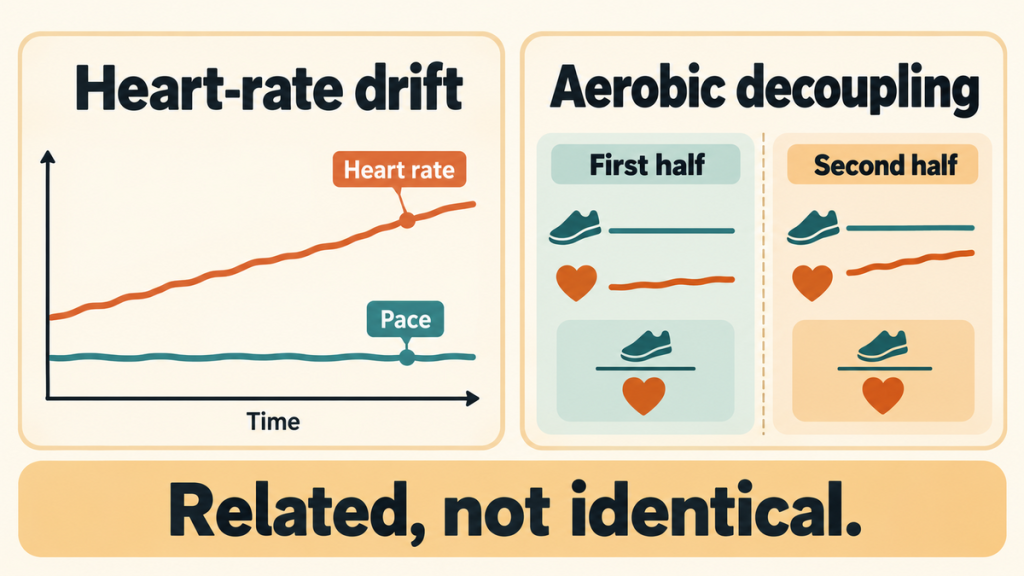
Heart-rate drift describes the physiological pattern of heart rate rising during sustained work. Aerobic decoupling is a calculation that compares how pace or power relates to heart rate across two portions of a workout.
A runner can have physiological drift during a run, but a software-generated decoupling percentage is only as sound as the data and comparison underneath it.
If the second half is uphill, warmer, windier or interrupted by traffic lights, the calculation may be accurate arithmetic applied to a poor experiment.
Why an Easy Run Can Look Harder on the Graph
A rising heart-rate line can look alarming. The temptation is to read it as fitness fading in real time.
There are other possibilities though.
• The day became warmer or more humid.
• I accumulated heat as the run continued.
• I became mildly dehydrated.
• The second half contained more climbing or headwind.
• My pace crept upward without my noticing.
• The route became technically harder.
• I was tired, stressed, under-fuelled or recovering from something.
• The chest strap or optical sensor produced bad data.
• Stops, walks and auto-pause changed what the two halves actually contained.
The metric doesn’t identify the cause by itself. It tells me that the relationship between pace and heart rate changed. The runner, the route and the rest of the evidence have to help explain why.
That is one reason I’ve begun using both heart rate and perceived effort. Research continues to support RPE and the talk test as practical ways to monitor aerobic exercise intensity. They don’t make heart-rate data unnecessary.
My BlackToe Run That Was Not a Drift Test
One of my BlackToe Holiday 10K sessions gave me a useful example precisely because it could not answer the drift question.
The prescription for Week 4 Run 3 was 45 minutes:
• 5 minutes of brisk walking
• 35 minutes of easy-endurance running at RPE 3 to 4
• Secondary heart-rate guidance of 130 to 149 beats per minute
• 5 minutes of cooldown walking
I completed the full session and divided the running into 10, 10, 10 and 5-minute portions. My overall RPE was 3 to 4, matching the prescription. I could run and chat without gasping. Once I was moving, cadence remained mainly around 159 to 164 steps per minute. A tight mid-back began at 3 out of 10, stayed at 3 during the run and eased to 2 afterward.
So far, that sounds like a successful easy-endurance run, yet the heart-rate trace, however, had other ideas.
The strap was still asleep after I started running
My pace and cadence shifted into ordinary running values, roughly 8:00 to 8:30 per kilometre and around 160 steps per minute, while the strap continued to report heart rate in the 50s. It then crawled through implausibly low values for several minutes.
The Garmin FIT file preserved the readings faithfully. The sensor was the unreliable part.
Later portions of the heart-rate trace became more believable, but the opening problem contaminated the first-half comparison and the whole-session average. The route was also gently rolling, and there were brief walking or stationary interruptions.
My AI coach therefore declined to calculate formal aerobic drift. I believe that was the right call.
The assessment didn’t throw away the entire run. It used the credible evidence to decide that the workout purpose was achieved. It only refused to use this particular activity to revise my heart-rate zones or make a claim about aerobic decoupling.
That distinction is central to my AI running coach experiment. Data can be useful without being suitable for every possible calculation.
My Easy-Run Drift Validity Check
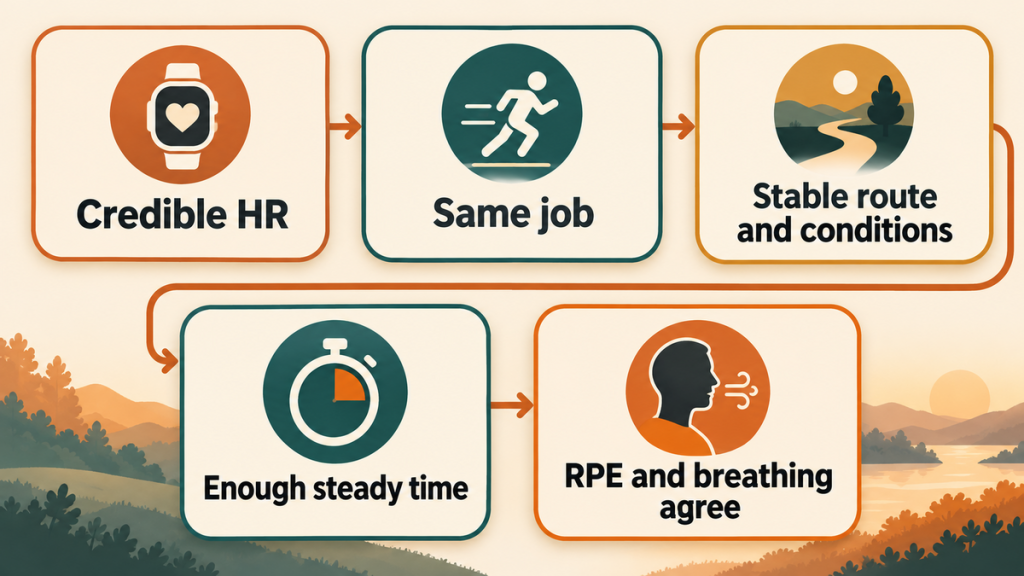
Before I accept a drift percentage, I now want five questions answered.
1. Was the heart-rate signal believable?
A smooth-looking line is not enough. Heart rate should respond plausibly when pace and cadence change. Sudden drops, flat sections at implausible values, abrupt spikes or a long delay after running begins deserve suspicion.
My Garmin FIT-file workflow lets me inspect the timestamped record rather than trusting one whole-run average. If the signal is broken, the percentage doesn’t become more trustworthy because software calculated it to one decimal place.
2. Were the two halves doing the same job?
A useful comparison needs similar work.
If the first half contains warm-up walking and the second half contains continuous running, I’m not measuring drift. I’m comparing different activities. The same problem appears when a structured workout puts faster work in one half, when the route climbs late or when a cooldown is included in the calculation.
The comparison window should match the steady portion of the prescription, not merely the midpoint of the saved activity.
3. Were pace, terrain and conditions stable enough?
Perfect laboratory control isn’t required, but obvious changes matter.
A flat out-and-back on a calm day is a cleaner candidate than a rolling loop with several crossings. A route that descends early and climbs home can manufacture an apparent loss of efficiency even when effort was well managed.
And the weather? Heat and dehydration can raise cardiovascular strain during prolonged exercise. That doesn’t automatically make the run unsuccessful. It means I should not interpret the number as fitness alone.
4. Was the steady section long enough?
Drift is a time-dependent phenomenon. A short easy run with a long warm-up may not contain enough stable running to reveal much for the AI to get to work crunching percentages.
5. Did RPE, breathing and mechanics agree?
If my heart rate rises slightly but RPE stays at 3, conversation remains easy and cadence and form remain controlled, that’s different from heart rate rising while breathing becomes strained, mechanics deteriorate and I report effort climbing to 6.
Neither side automatically defeats the other.
A mismatch is a prompt to investigate, not to choose whichever source tells the more flattering story.
The Four Verdicts I Want From an AI Coach
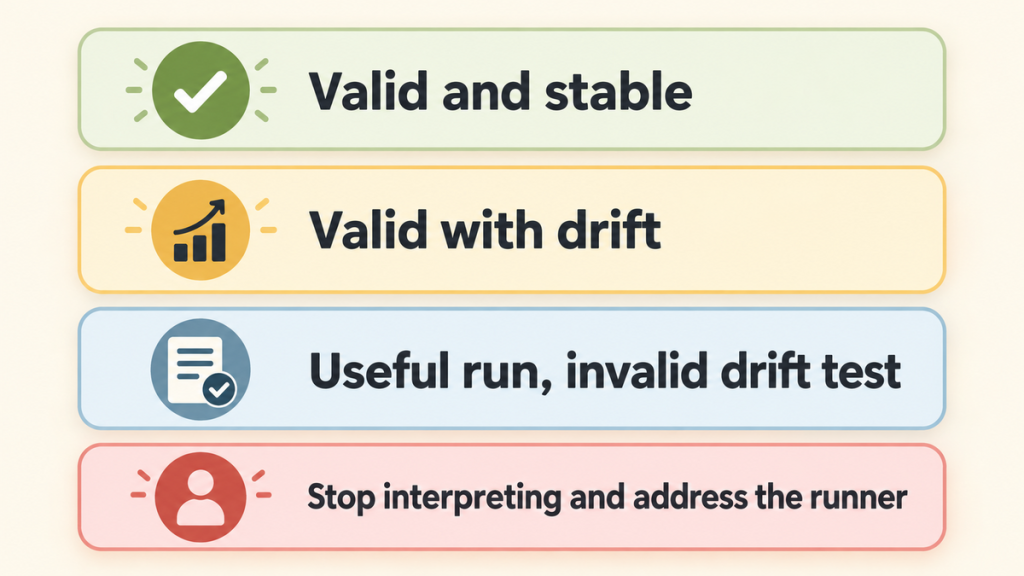
I don’t want every upload to produce a dramatic fitness score. I want a clear verdict about the evidence.
Valid and stable
The heart-rate signal is credible, the steady segment is comparable and pace-to-heart-rate efficiency changes little. This supports the interpretation that the effort remained aerobically controlled for that duration and those conditions.
Valid, with meaningful drift
The signal and comparison are credible, and the second portion becomes materially more costly. That may justify looking at duration, pace, heat, hydration, fatigue and recent training. One run can raise a question. A series of comparable runs is much better evidence of a trend.
Useful run, invalid drift test
This was my Week 4 example. The workout can achieve its purpose even when sensor error, hills, stops or changing structure make drift uninterpretable.
It’s not a consolation prize, but more like accurate source handling.
Stop interpreting and address the runner
If the run includes severe, unusual or worsening symptoms, movement-altering pain, chest discomfort, faintness or concerning shortness of breath, the job is not to improve the data analysis. The runner needs the appropriate qualified help.
AI should know when to step back.
How I Ask CoachChat to Assess Drift
I give CoachChat the workout prescription first. Then I provide the decoded Garmin evidence and my post-run report.
The useful request is not:
“Calculate my heart-rate drift and tell me whether I am fit.”
It is closer to this:
Assess whether the steady running portion is valid for pace-heart-rate drift analysis. Check heart-rate signal credibility, workout structure, stops, terrain, weather, pace stability, RPE, breathing and symptoms. If the comparison is invalid, say so and explain why. If it is valid, calculate the change, state the method and limits, and do not treat one run as a fitness trend.
That wording matters because it asks the AI to qualify the evidence before performing the arithmetic.
My post-run debrief prompt supplies the context the FIT file cannot contain. My article about what Strava missed shows what can happen when a system explains a run from a narrower set of inputs. Neither article argues that data are bad. They argue that the source and the question have to match.
What I Would Compare Across Several Easy Runs
One clean drift value can be interesting. Several runs that are genuinely comparable become useful.
I would look for:
• Similar workout purpose and steady-section duration
• Similar route or terrain profile
• Similar weather and wind, or an explicit caution when they differ
• Credible heart-rate data from the same source
• Similar RPE and breathing control
• Pace at approximately the same heart rate
• Heart rate at approximately the same pace
• Pace, heart-rate and cadence relationships
• Change between comparable first and second halves
• Symptoms, sleep, readiness and other reasons two runs may not belong in the same comparison
The phrase “genuinely comparable” = Comparing apples to apples.
This is also where the possible Plus50Fit Run Compare tool fits into the experiment. It currently reads the folders created by my Python FIT Tool and can compare multiple runs while carrying environmental and comparability cautions forward. The two applications may eventually become free downloadable Windows tools that process FIT files locally, but that is a possibility, not a promised release.
The principle is already usable without my software:
Coach prescription → Garmin FIT evidence → runner context → post-run assessment → multi-run trend comparison
What Heart Rate Drift Does Not Get to Decide
A drift percentage does not get to decide whether I am a real runner.
It doesn’t get to erase a fun run, diagnose a medical problem or prove that one slow day represents declining fitness. It doesn’t get to overrule pain, unusual symptoms or common sense. It also doesn’t get to make comparisons where runs aren’t comparable.
I enjoy the data, but I don’t live or die by them.
That balance matters more as I train after 50. Longevity is not only about collecting clean metrics. It is about staying curious, staying honest and continuing to enjoy the thing I am trying to preserve.
The Takeaway
Easy run heart rate drift can be a useful second-layer measure of how pace and cardiovascular effort stayed connected during sustained running.
Before I trust it, I want to know that:
• The heart-rate signal was credible
• The comparison used genuinely similar work
• The route and conditions did not obviously distort the result
• The steady section was long enough to be meaningful
• RPE, breathing, mechanics and symptoms were considered
• One run was not promoted into a long-term trend
My Week 4 BlackToe run passed the workout test and failed the drift test.
That is not a contradiction.
I completed the intended easy-endurance time at the prescribed effort, maintained conversational control and finished with less back discomfort than I started with. The broken opening heart-rate trace simply meant that this run could not answer every question I wanted to ask.
Sometimes good coaching produces a number.
Sometimes it protects me from one.
Frequently Asked Questions
Is heart-rate drift normal during an easy run?
Some rise in heart rate during sustained exercise can be normal, especially as duration, body temperature and environmental stress increase. The size and meaning of the change depend on pace, conditions, hydration, terrain, fitness, sensor quality and the section being compared.
Does more than 5 percent drift mean my easy run was too hard?
Not automatically. Five percent is a commonly used coaching threshold, not a universal biological border. First confirm that the data are credible and the two portions are comparable. Then interpret the result alongside RPE, breathing, conditions and repeated runs.
Can hills create apparent heart-rate drift?
Yes. If the later portion has more climbing, headwind or technical difficulty, heart rate may rise or pace may fall because the external demand changed. That is not a clean steady-workload comparison.
Should I use pace or heart rate to control an easy run?
I use the workout purpose, RPE and breathing as primary guides, with heart rate as useful secondary evidence when the signal is credible. Pace is an outcome that can change with heat, terrain, fatigue and other conditions.
Can AI calculate aerobic decoupling from a Garmin FIT file?
It can if the FIT file is decoded into usable record-level data and the analysis method is defined. A responsible analysis should first validate the heart-rate signal, isolate the correct steady section and disclose stops, terrain, weather and other comparability limits.
Should one drift result change my training plan?
Usually not by itself. One run may justify a safety decision or a question for the next session. A plan-level change deserves credible evidence, runner context and preferably a pattern across comparable workouts.
AI DISCLOSURE
I developed this article with AI assistance for current research, source checking, structure and drafting. AI is also part of the coaching process being examined. The running experience, opinions, decisions and final editorial judgment are my own.
SAFETY DISCLAIMER
This article describes my personal training experiment. It is not medical advice, diagnosis, rehabilitation guidance or an individualized training prescription. Heart-rate data and consumer wearables can be wrong. AI cannot examine a runner or replace an appropriate healthcare professional or experienced human coach. Stop exercise and seek qualified help for severe, worsening or unusual symptoms, chest discomfort, faintness, concerning shortness of breath, movement-altering pain or whenever you are concerned about your health. Garmin is not affiliated with or responsible for Plus50Fit or this experiment.