A lower heart rate at the same pace looks like one of running’s cleanest progress reports.
Same speed. Fewer beats. Clearly, the engine has improved.
I want that to be true. At 68, rebuilding toward the BlackToe Holiday 10K, I’m happy to find that it’s working. I’ve also become a late-blooming running-data nerd, so two similar pace traces and a handful of heart-rate beats can keep me entertained far longer than I should probably admit.
But I’ve learned that “same pace” doesn’t automatically mean “same work,” and a lower heart-rate average doesn’t automatically mean better fitness. The route may have changed. The weather may have changed. I may have slept better, started fresher, worn different shoes, taken more walk breaks or my heart rate monitor was fibbing.
I still think lower heart rate at the same pace can be useful. I just don’t think one number gets to declare victory.
What a Lower Heart Rate at the Same Pace May Mean
The hopeful interpretation is reasonable. With consistent aerobic training,anyone’s cardiovascular system can become more capable of supporting a given submaximal workload. At the same comparable pace, a lower heart rate may be one sign that the work costs less than it used to.
That’s why runners ask versions of the same question online: “How can I run faster with a lower heart rate?” or “When will my easy pace improve?” A current Suunto explanation of running heart rate makes the point that the same pace can require fewer beats as an aerobic base develops.
Heart rate is one part of cardiac output, alongside the amount of blood pumped with each beat. Oxygen delivery, running economy, temperature regulation, muscle recruitment and perception all contribute to the cost of moving at a given pace. A lower number can fit the story of improved fitness without proving the entire story by itself.
Heart rate is a response, not a direct laboratory measurement of running economy, oxygen consumption or fitness. It is useful precisely because it is accessible, not because it knows everything.
My earlier article looked at the question from the other direction: pace at roughly the same heart rate. This version asks whether the heart rate has changed at roughly the same pace. They are related lenses, not interchangeable calculations.
The Same Pace Is Not Always the Same Work

My Garmin can show 7:30 per K on two days and convince me to place my HR averages side by side. But before I do, I should ask if my body was solving the same problem.
Heat, humidity and wind can raise the cost
In warm or humid conditions, more blood flow is involved in cooling the body. Heart rate can rise even if pace stays put. Wind can create the same visual pace while demanding more work in one direction and offering help in the other.
A cool October run should not automatically defeat a hot August run in a fitness contest. It may simply have better weather.
Hills, surface and route interruptions change the comparison
A rolling trail, a flat path and a treadmill can all produce the same average pace through very different patterns. Corners, traffic lights, GPS wobble and brief walks can lower or raise the average in ways that disappear when I only look at the session summary.
This is one reason I care about the timeline inside a Garmin FIT file. It lets me separate the running section that focused the workout’s purpose from the warm-up, cooldown, stops and HR sensor glitches.
Sleep, readiness, fatigue and health still belong in the evidence
Whether I’m rested, or tired, I can hold the same pace at different internal costs. Stress, illness, hydration, accumulated training and some medications can also affect my heart rate. None of that means the feeback number is useless. It just means that feedback on a particular day.
My RPE for running can give it context. If heart rate is lower but the run feels much harder, I don’t call the mismatch an automatic improvement. If my HR, breathing and RPE all settle lower across comparable runs, I’m thrilled.
Sensor quality can create imaginary fitness
The most flattering heart-rate trace my tech captures might also be the least believable.
Optical wrist sensors estimate pulse from changing blood volume at the skin. Chest straps use a different signal, but they can still suffer from dry contacts, connection problems, poor placement or a tired battery. A review of photoplethysmography explains the optical method and the practical factors that can affect the signal.
My own BlackToe .fit files have included an ridiculously low start, a jump, a dropout and then a later section that looked resonable. The file preserved all of it. That didn’t turn bad data into good evidence. It showed me that I should consider other metrics.
I wrote about that mismatch in What Strava Missed About My Run.
A lower heart rate is only good news after I know that the capture was sound.
My Five-Gate Comparison
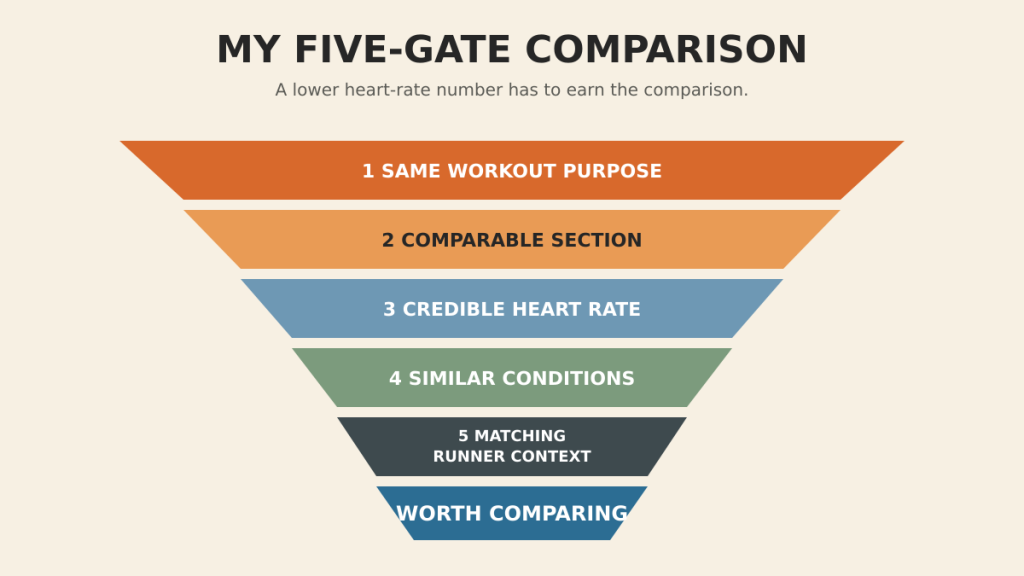
I now make a heart-rate-at-pace comparison pass five gates before I give it much weight.
- Same workout purpose. I compare easy aerobic running with easy aerobic running, not an easy day with a progression, intervals or a race.
- Comparable section. I use continuous running windows after the warm-up and before late-run fatigue, unless fatigue is the question I am testing.
- Credible heart-rate signal. I exclude obvious dropouts, spikes, cadence lock and sections where the sensor was still settling.
- Reasonably similar conditions. I record route, terrain, temperature, humidity, wind and footwear, then flag meaningful differences.
- My run debrief. I keep RPE, breathing, sleep, readiness, pain, walk breaks, observations and the original prescription beside the device data.
Hitting the mark on all five delivers enough useful information for analysis.
This is also where my provisional heart-rate zones comes in.
How I Compare the Actual Running Sections
If one run contains five minutes of walking and another doesn’t, the averages will appear different even when the continuous running is almost identical.
I might compare the middle 15 or 20 minutes of two easy runs once my HR settled. I want pace within a certain range, no major stop, credible heart rate and enough duration that one short fluctuation isn’t over-represented.
I also look at relationships:
- Was my heart rate lower across most of the comparable window, or only for a minute?
- Was my pace similar, including hills and GPS noise?
- Did my cadence and mechanics remain stable?
- Did my RPE and breathing agree that the work felt easier?
- Was late-run drift smaller, or did the comparison end before drift could appear?
- Did the next few runs support the same direction?
My article on easy-run heart-rate drift looks within one run to see how cardiovascular cost changes over time. Heart rate at the same pace looks across runs. Both can be distorted if the halves or sessions are not actually comparable.
One Run Is a Clue, Not a Fitness Verdict
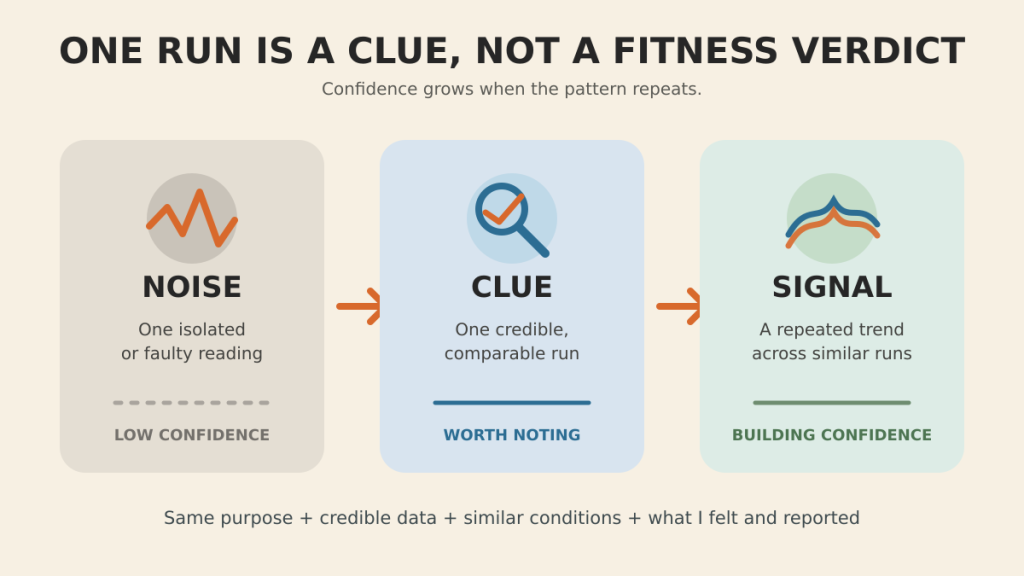
Suppose I run a flat kilometre at 7:30 per kilometre and 145 bpm. Three weeks later, the same pace appears at 139 bpm.
Six beats lower? Wow!. But it doesn’t immediately prove a six-beat fitness gain.
One credible comparison is a clue. If several comparable runs show the same direction while RPE, breathing and recovery remain stable or improve, the clue begins to look like a trend. If the difference disappears next, well, I’ve learned something about normal variability.
What My BlackToe Rebuild Keeps Teaching Me
Restraint, for one.
Some BlackToe easy-run sections have been good enough to examine. Others have had faulty early heart-rate data, different terrain, interruptions or too little comparable running. I’ve been tempted to force every file into a trend line. It doesn’t work.
CoachChat’s (my AI coach) job is not to reward me with improvement after every FIT file upload. It prescribes a workout, checks what Garmin recorded, adds what I reported and makes its assessment. Sometimes the honest assessment is simply that I completed the intended easy work and the heart-rate comparison is inconclusive. It’s still a successful run.
I enjoy running. I also enjoy drilling down and sussing out all the data. I can be fascinated by the graph and not live or die by it.
My cadence article made the same point about rhythm: running cadence over 50 is a clue that needs pace, terrain, symptoms and purpose around it. Heart rate deserves no less context.
Where AI Helps, and Where It Can Fool Me Faster
AI is useful here because the comparison has more moving parts than one pair of averages. It can align workout sections, screen for obvious sensor faults, match pace and heart-rate bands, preserve environmental cautions and ask whether RPE or symptoms disagree.
It can also produce a polished explanation of a bad comparison.
In my AI running coach experiment, I want to see how CoachChat reached its assessment:
Coach training program → Garmin FIT metrics → My run debrief → post-run assessment → multi-run trend comparison.
It’s important to me that AI compare the same kinds of runs. If the raw signal is poor, AI’s calculations are wholly useless. If I don’t provide a run debrief, heat, pain or fatigue can be mislabelled as fitness. If only one run is available, there is no trend to assess.
My local Plus50Fit FIT Tool combines the objective activity record with context the file cannot contain, including the prescribed workout, RPE, weather, terrain, sleep, readiness, pain, footwear, observations and Coach questions. Plus50Fit Run Compare then examines suitable folders for pace at roughly the same heart rate, heart rate at roughly the same pace, pace-heart-rate-cadence relationships, aerobic efficiency, change between workout halves and chronological trends. It also carries comparability cautions forward.
Those Python tools may eventually become free downloadable Plus50Fit FIT Tools for Windows, with local file processing, an installer or portable ZIP, sample files and a quick-start guide. That remains a possibility, not a promised release. Testing beyond my computer, installation guidance, privacy, digital signing, licensing, maintenance and support all need answers first.
The method does not need my software. A runner can begin with a notebook and five honest questions.
My Rules for Reading a Lower Number
- I don’t compare a questionable sensor section.
- I don’t compare sessions simply because their average pace matches.
- I keep the workout purpose and running section attached.
- I record the weather, terrain and what changed in me.
- I ask whether RPE, breathing and recovery broadly agree.
- I look for repetition before calling the difference a trend.
- I let an inconclusive comparison remain inconclusive.
I think the last rule may be the most useful. Running data becomes more trustworthy when I stop demanding that every graph give me an answer.
A lower heart rate at the same pace can be encouraging. When similar runs repeatedly show it, the sensor is credible and the human context agrees, I am willing to call it evidence of improving aerobic efficiency.
Until then, it is a clue. Interesting, welcome and worth watching, but still a clue.
Frequently Asked Questions
Does a lower heart rate at the same pace mean I am fitter?
It may. A repeated lower heart rate during genuinely comparable submaximal running can support the interpretation that the workload has become less costly. One run cannot separate fitness from weather, terrain, recovery, medication effects or sensor error.
How many runs should I compare before trusting the trend?
There is no universal magic number for ordinary outdoor runs. I want several credible comparisons across weeks, with similar workout purpose and conditions, before using the pattern to influence training. More variability requires more caution.
Should I compare average heart rate for the whole run?
Usually not by itself. Warm-ups, cooldowns, walk breaks, hills, stops and sensor settling can distort the average. Comparable continuous running sections often answer the question better.
What if heart rate is lower but the run feels harder?
Treat the disagreement as useful information. Check sensor quality, fatigue, muscular strain, weather, symptoms and whether the pace or terrain was truly comparable. A flattering number should not overrule unusual difficulty or concerning symptoms.
Can an AI running coach detect improving aerobic fitness?
AI can organize repeated pace, heart-rate and context data and flag patterns. It cannot guarantee that the sensor is correct, diagnose a health issue or prove causation from outdoor runs. The quality of the conclusion depends on the prescription, evidence, context and comparison rules it receives.
AI Disclosure
I developed this article with AI assistance for current search research, source checking, structure and drafting. AI is also part of the coaching process being tested. The running experience, reports, opinions and final publication decisions are my own. I will review and revise the wording before publication.
Safety Disclaimer
This article documents one recreational runner’s N=1 experiment. It is not medical advice, diagnosis or an individualized training prescription. Heart rate can be affected by health conditions and medications. Do not change medication or training because of one wearable reading. Stop exercise and seek appropriate medical care for chest pain, fainting, severe or unusual breathlessness, new neurological symptoms or other urgent concerns. Consult an appropriate qualified professional before beginning or materially changing training if you have an injury, cardiovascular concern, chronic condition or medication-related question.