
The most important number I type after many runs is one Garmin didn’t calculate. It’s my RPE, or rating of perceived exertion: how hard the effort felt to me.
That word “felt” can make the number sound soft beside a heart-rate trace, kilometre splits and cadence recorded to a decimal place. Pace tells me what I produced. Heart rate shows one part of how my body responded. RPE tells me what the work cost from the inside.
At 68, I’ve become a late-blooming running-data nerd. I enjoy opening a FIT file and following the clues. I also enjoy running for its own sake, and I don’t want the watch deciding whether a run was worthwhile. RPE keeps my own experience in the evidence.
My perception can be influenced by heat, hills, sleep, soreness, mood, expectations and the satisfaction of finishing. That subjectivity is exactly why I record it. Those influences are part of the run, even when the device can’t see them.
What RPE Actually Measures
RPE tells me how hard I’m working. Gunnar Borg’s original work produced the familiar 6-to-20 scale and later category-ratio approaches. Many running plans now use a simpler 0-to-10 or 1-to-10 scale. A scale of 1-to-10 suits me fine.
The scale only becomes useful when I keep its meaning reasonably consistent. An RPE 3 can’t mean “gentle jog” on Tuesday and “barely survived” on Sunday. I don’t need laboratory precision, but I do need stable anchors. I still struggle to nail RPE down.
The Cleveland Clinic’s RPE overview describes perceived exertion through signals such as breathing, heart rate, muscle fatigue and sweating. New York Road Runners also uses RPE as a practical intensity guide. Neither source turns the scale into a perfect substitute for every other measure.
My Working RPE Anchors
These are the RPE zones I currently use in CoachChat debriefs. They are working descriptions, not universal pace zones or a prescription for another runner.
| RPE | How it feels to me | Where it may appear |
| 1 to 2 | Very light. Walking, warming up or deliberately backing off. | Warm-up, cooldown or recovery movement. |
| 3 to 4 | Easy and controlled. I can sustain it and breathing stays comfortable. | Most easy and endurance running in my current rebuild. |
| 5 to 6 | Steady work. Clearly running, but not straining or racing. | Controlled steady sections or a progression. |
| 7 to 8 | Hard and purposeful. Talking is limited and the effort needs focus. | Tempo, threshold work or longer intervals, depending on the prescription. |
| 9 to 10 | Very hard to maximal. Limited duration and little room left. | Short hard repetitions, a test or the end of a race. |
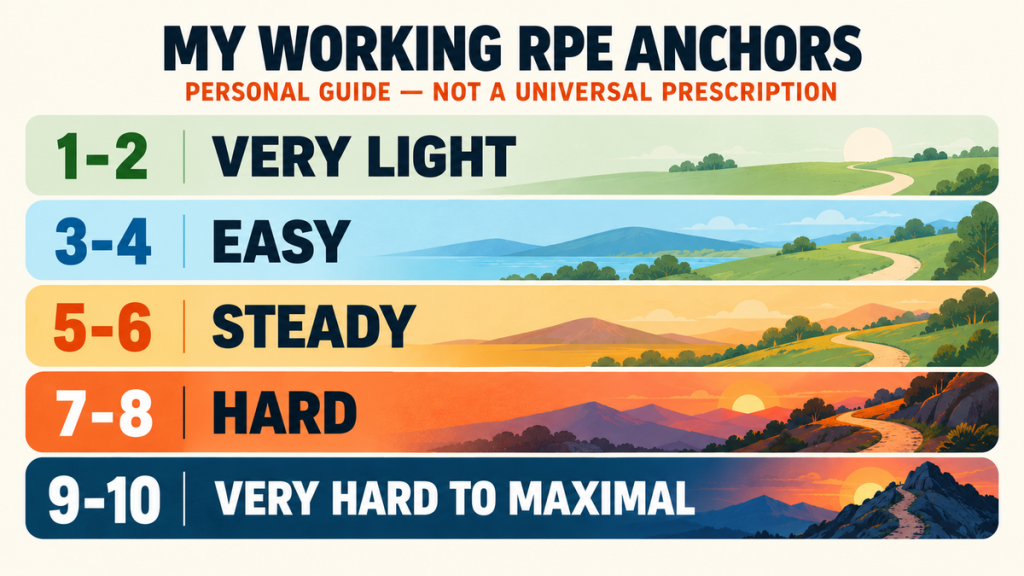
I don’t assign every number a pace. The whole point is that an easy effort can slow on a hill, in heat or on tired legs without ceasing to be the intended effort.
Target RPE, In-Run RPE and Session RPE Are Not the Same Thing
My workout can contain three different RPE questions. Mixing them together creates fake precision.
Target RPE
CoachChat may prescribe an easy run at RPE 3 to 4. That is the intended intensity, not proof of what happened.
In-run or section RPE
A section rating describes what a particular part felt like. An easy run can begin at 3, climb to 4 on a hill and settle again. Intervals can reach 8 while the recovery jogs feel like 2 or 3. If I didn’t record a section RPE, I don’t want CoachChat inventing it afterward.
Session RPE
My overall rating asks what the workout felt like as a whole. Research on session RPE developed it as a simple way to summarize internal training load across different kinds of exercise. When practical, I rate the session after I’ve had a few minutes to settle so the final hill or finishing burst doesn’t swallow the rest of the run.
The number still needs a qualifier. “RPE 4, controlled overall, but my calves felt unusually heavy” gives CoachChat more to work with than just an RPE of “4”.
What Pace, Heart Rate and RPE Each Contribute
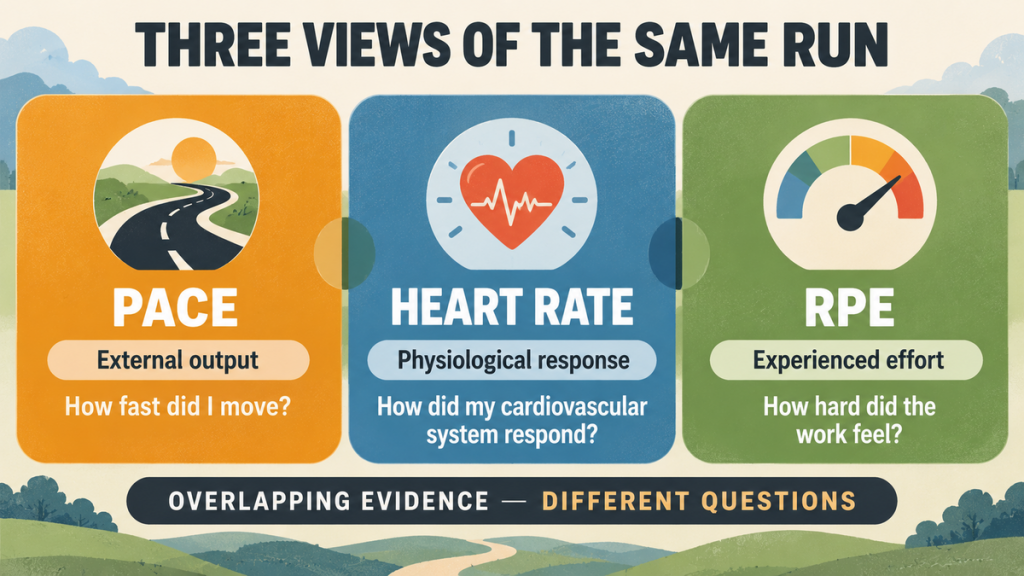
Each metric contributes.
- Pace is the external result. It matters when the workout calls for a specific pace, and it tells me how quickly I moved.
- Heart rate is a physiological response. It helps me judge aerobic cost when the signal is believable and I account for lag, heat, hills, fatigue and medication or health factors that may affect it.
- RPE is the experienced effort. It can register heavy legs, breathing strain, poor recovery or an unexpectedly easy day before the other numbers tell the whole story.
It’s not necessarily an RPE versus heart rate or pace versus feel. I use the metric that best matches the workout, then let the others explain or challenge what I saw.
For pace-specific intervals, I want to execute the intended pace, use feel as an immediate guardrail and inspect heart rate afterward. For easy running, RPE and breathing can guide the effort while pace responds to the day. Heart rate can often fill in the blanks.
That division of labour is also why my heart-rate zones remain provisional and why I compare pace at roughly the same heart rate across suitable runs.
The Day the Sensor Had a Bad Run
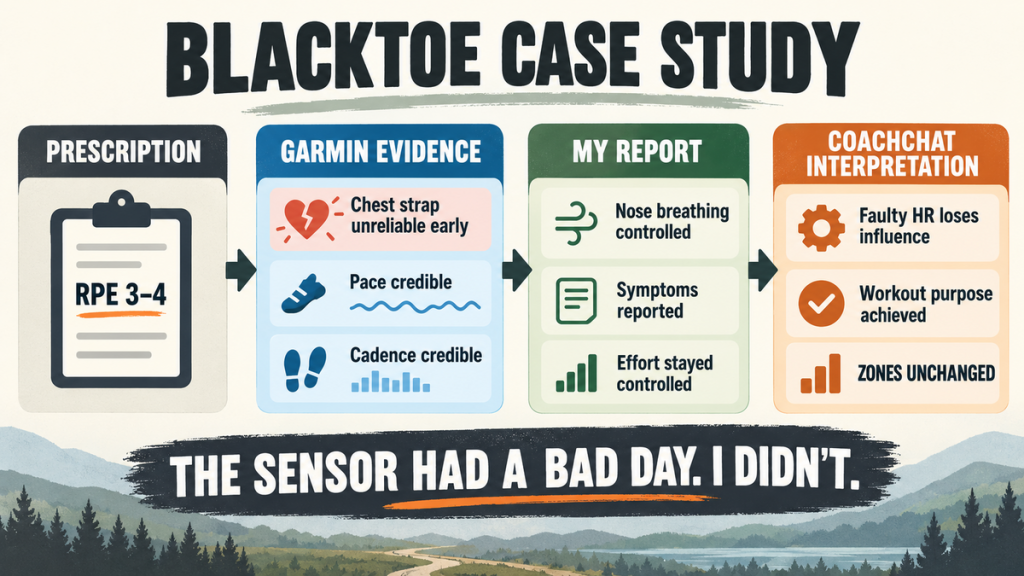
A BlackToe Week 4 aerobic-control workout gave RPE a chance to earn its place. CoachChat prescribed 40 minutes with controlled running at RPE 3 to 4 with heart rate as a backup. My chest strap began by reading too low, then too high, lost its connection and only became believable later.
If heart rate had been the judge of everything, the run would have become either a failure or a mystery. I reported overall RPE 3 to 4, complete nose breathing, stable cadence once I settled, controlled pace and a mid-back ache that didn’t worsen. Garmin still contributed useful pace and cadence evidence. The corrupted early heart-rate values didn’t contribute to the assessment.
CoachChat assessed that the workout purpose was achieved and left my provisional zones unchanged. I explored the broader lesson in what Strava missed about one of my runs. The sensor had a bad day. I didn’t.
RPE Is Not Readiness, Pain or Enjoyment
I’ve learned and continue to learn:
- Readiness asks how prepared I feel before starting.
- RPE asks how hard the exercise feels while I’m doing it or when I assess the completed session.
- Enjoyment answers whether I liked the run. A hard run can be great fun. An easy run can feel tedious.
On one easy-endurance day, my readiness was only 2 out of 5 while the completed run still landed at the prescribed RPE 3 to 4. I still respected low starting score, but it didn’t predict failure. On another day, an RPE 3 run with increasing pain wouldn’t become safe because the effort was easy.
Those distinctions help my post-run debrief remain grounded and useful. They also stop CoachChat from flattening every human report into one mood score.
How I Make an RPE Number More Useful to CoachChat
I give CoachChat enough detail to understand what the number belongs to:
- The prescribed RPE and the purpose of the workout.
- My overall session RPE, plus section ratings if I actually recorded them.
- When the effort changed and what seemed to change it.
- Whether the strain felt cardiovascular, muscular, mechanical or symptom-related.
- Breathing, including my personal NBr note when I deliberately use nose breathing.
- Readiness, sleep, weather, terrain, interruptions and anything unusual.
- What happened later that day and on the next run when recovery is part of the question.
The cornerstone of my AI running coach experiment is the conversation between the assignment, the run and the next decision. RPE is one of the few inputs that comes directly from me rather than the watch.
I can follow the evidence from beginning to end: CoachChat’s prescription, the Garmin FIT file, what I felt and reported, the post-run assessment and patterns across several runs. My local FIT Tool preserves those pieces together, and Run Compare can examine suitable sessions without pretending that every pair belongs side by side.
The experiment may eventually produce free Windows tools readers can use on their own computers. That remains a possibility, not a release promise. The method doesn’t need software: write down the intended effort, what the work felt like and why.
How I Calibrate RPE Without Turning It Into Another Obsession
RPE gets better with practice. I compare the rating with breathing, credible heart rate, pace, terrain and how long I could realistically have continued. Over several similar runs, the anchors become more personal and less theoretical.
I also watch for ways I can fool myself:
- Rating the run I hoped to have instead of the one I had.
- Letting the final minute define the entire session.
- Calling an effort easy because the pace looks slow.
- Calling it hard because the pace is faster than expected.
- Ignoring heat, wind, hills, poor sleep or accumulating fatigue.
- Treating muscle fatigue, breathlessness and pain as though they mean the same thing.
A 1-to-10 scale suggests a precision I don’t really possess. The difference between 4 and 5 may be fuzzy. I care more about consistent anchors, the direction of change and whether the number agrees with the rest of the run.
RPE Will Matter More as My Runs Change
As the BlackToe training becomes more demanding, pace-specific work will return. RPE won’t replace pace in those sessions. It will help me notice when the planned pace is producing the wrong cost.
That can mean completing the session as intended, adjusting it or accepting that a failed workout is useful evidence. I can compare the planned pace, actual execution, heart rate, RPE, readiness and the runs that follow. CoachChat can then decide whether the body absorbed the work or whether the prescription arrived too soon.
I’m looking for timed growth, not burnout that defeats the long-term race goal. A watch can document the attempt. My RPE helps describe what the attempt demanded.
RPE: Human Data
RPE for running is not the enemy of data. It is data, collected from the only instrument that experienced the whole session.
I still want pace when pace matters. I still value a trustworthy heart-rate trace. I still enjoy cadence, FIT files and my absurd pleasure comparing two similar running sections. None of them can tell me, on their own, whether I was straining, protecting an ache, feeling unexpectedly strong or forcing a workout my body wasn’t ready to absorb.
Frequently Asked Questions
What does RPE mean in running?
RPE means rating of perceived exertion. It is a numerical estimate of how hard the exercise feels. I use a 1-to-10 scale and keep personal anchors for easy, steady, hard and near-maximal work.
Is RPE better than heart rate for running?
Neither is universally better. RPE captures the experienced cost of the work. Heart rate records one physiological response. Heat, hills, fatigue, sensor errors and some medications or health conditions can change how useful heart rate is on a particular day. I use both when they are relevant and credible.
What RPE should an easy run be?
Many running guides place easy running around 3 to 4 on a 10-point scale, but the exact anchor depends on the scale and the person. My current easy and endurance prescriptions commonly use RPE 3 to 4 with comfortable breathing. That is my working system, not an individualized prescription for everyone.
Should I rate each interval or the whole workout?
They answer different questions. A hard repetition may reach RPE 8 while the session as a whole feels like 6. Record section ratings when they matter, then give a separate overall session rating. Don’t assume one number describes every part.
Can an AI running coach judge whether my RPE is accurate?
It can compare the rating with pace, heart rate, breathing, terrain, symptoms and similar runs, then flag a mismatch or ask better questions. It can’t feel the effort or prove that a subjective number is correct. I remain responsible for the report and the decision to stop when something feels wrong.
AI Disclosure
I developed this article with AI assistance for research, source checking, structure and drafting. AI is also part of the coaching process being tested. The running experience, RPE reports, opinions and decisions are my own. I will review and revise the article before publication.
Safety Disclaimer
This article describes my personal N=1 training experiment. It is not medical advice, diagnosis, rehabilitation guidance or an individualized training prescription. RPE does not make concerning symptoms safe. Stop exercising and seek appropriate medical care for chest pain, fainting, severe or unusual shortness of breath, new neurological symptoms or other urgent concerns. Consult a qualified healthcare or exercise professional before beginning or changing training if you have an injury, cardiovascular concern, chronic condition or medication-related question.