When I searched for minimum strength training for older runners, the internet very quickly gave me five essential exercises, seven non-negotiable moves, ten minutes a day, two full gym sessions a week, mobility before every run, mobility after every run and enough variations to fill a small encyclopaedia.
I’ve tried to make sense of that abundance. I’ve assembled my own routine from multiple sources, kept exercises I enjoy and quietly declined to do every movement somebody has declared indispensable. That is not rebellion. It is an admission that a theoretically perfect program has no effect if I avoid doing it.
At 67, I am trying to build the runner who can train next week, next year and on my Road to 70. That means strength matters. So do balance, power, mobility, tissue capacity, recovery and plain old adherence. The question is not whether every older runner should perform my exact routine. The better question is: what movement needs should a useful routine cover, at the smallest dose I can sustain?
Why This Is Not Another “Best Exercises” List
I already have an article on why strength training matters for runners over 50. That post discusses muscle preservation, running economy, joint support and the routine I was using at the time. This article has a different job.
Here I am trying to solve the selection problem.
A squat can be useful, but so can a leg press, a sit-to-stand or another knee-dominant movement chosen for the person in front of us. A hip hinge can be trained with a deadlift variation, a cable pull-through or something else that fits the runner’s experience, equipment and tolerance. Exercise names matter less than the jobs we need the body to practise.
That shift from a sacred list to a movement audit also gives AI a sensible role. I can ask it to compare guidance, identify what my routine may be missing and help arrange the work around my running. I should not ask it to pretend that it has examined me.
The 2026 Guidance Is Thankfully Uncomplicated
The timing of this question is useful. In March 2026, the American College of Sports Medicine announced its first major resistance-training position update since 2009. The review synthesized 137 systematic reviews representing more than 30,000 participants.
The headline I take from ACSM’s 2026 resistance-training guidance is pretty unglamorous: consistency beats complexity. Moving from no resistance training to regular resistance training produces meaningful benefit. For most healthy adults, training all the major muscle groups at least twice a week matters more than chasing complicated methods, special equipment or a perfect periodized plan.
The Physical Activity Guidelines for Americans also recommend muscle-strengthening work for all major muscle groups on two or more days a week. For older adults, they add multicomponent activity that includes balance along with aerobic and strengthening work. The World Health Organization makes the broader point that any amount of physical activity is better than none and that muscle strengthening benefits everyone.
That does not turn two days into a magical prescription for every runner. It gives me a broadly defensible floor from which to build. My running schedule, health, training history, race phase and recovery still decide what those days look like.
My Working Audit: Push, Pull, Squat, Hinge, Step, Spring and Brace
The familiar push, pull, squat and hinge framework is a useful start for general strength. Running asks for a little more specificity, so I am experimenting with a seven-part editorial framework:
- Push: move resistance away from me, with an exercise appropriate to my shoulders, wrists and current ability.
- Pull: draw resistance toward me and strengthen the upper back and arms that help me maintain posture.
- Squat: train knee and hip extension through a range I can control.
- Hinge: load the hips and posterior chain without turning every repetition into a wrestling match with the floor.
- Step: train one-leg support, control and force production in a pattern that resembles locomotion.
- Spring: preserve or rebuild the ability to produce force quickly and use the stretch-shortening cycle.
- Brace: resist unwanted movement and transfer force through the trunk, rather than treating “core” as a contest to collect abdominal exercises.
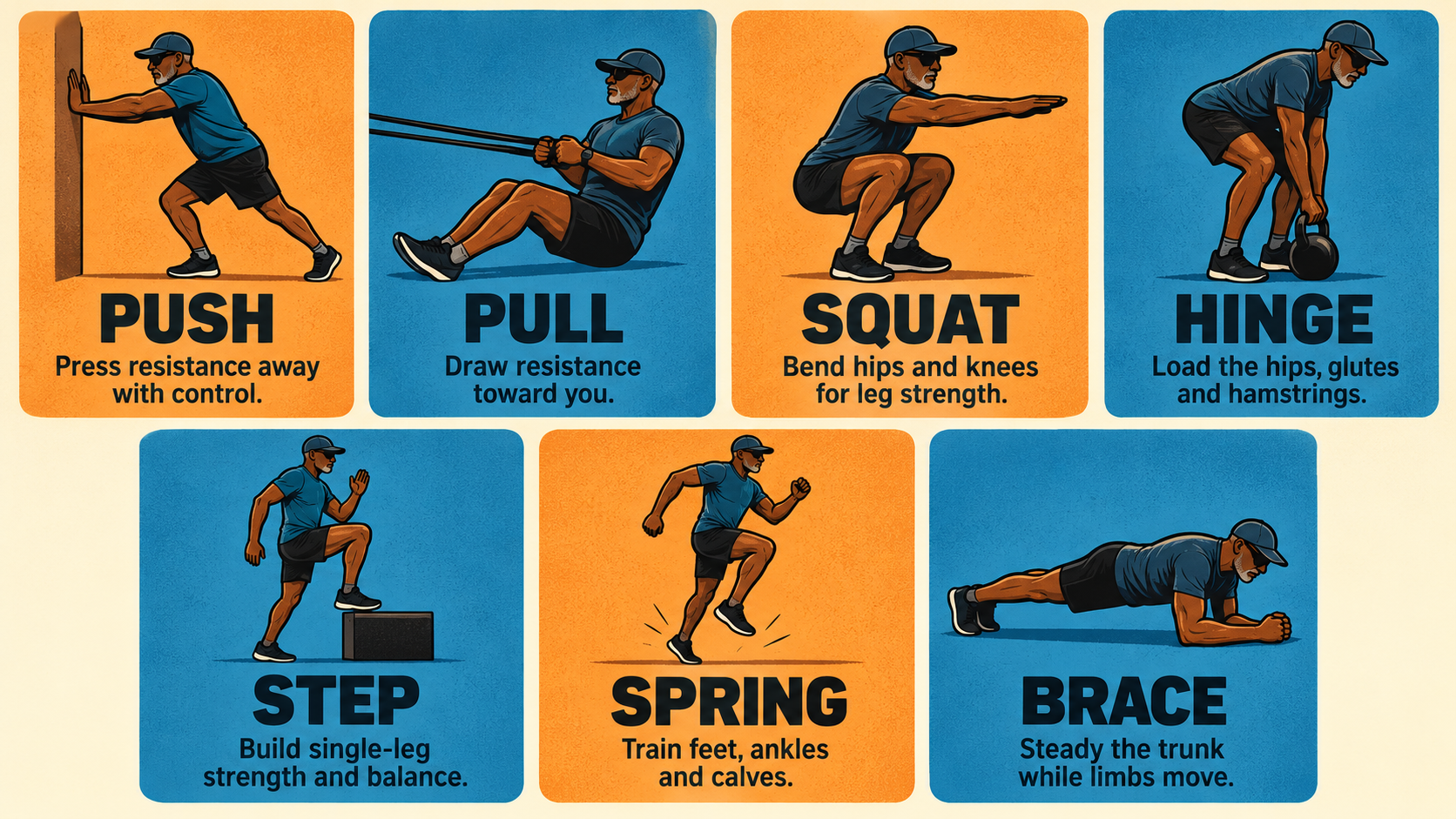
This is a checklist, not a finalized prescription. One exercise can cover several categories. A loaded step-up may train squat, step and brace. A farmer carry can challenge grip, posture, gait and trunk control. Balance can be built into split-stance and single-leg work rather than living in a separate twenty-minute routine.
Mobility sits around the framework. I do not think every runner needs to chase maximum range everywhere. I want enough usable range to perform my chosen movements and run without compensating, plus the strength to control that range.
What Minimum Strength Training for Older Runners Actually Means
There is no universal minute count or exercise count that deserves to be called the minimum effective dose for every older runner. “Minimum” has at least three meanings:
- The health minimum: regular strengthening of all major muscle groups, commonly organized across at least two days a week.
- The runner minimum: enough lower-body, trunk, balance and tissue-capacity work to complement repeated forward running.
- My minimum: the smallest routine I can recover from, progress and repeat while still completing the running that matters to me.
The 2026 ACSM update also helps here. Heavier loads, additional volume and faster intended lifting can optimize particular outcomes such as strength, muscle growth or power, but advanced techniques are not prerequisites for general benefit. Bands, bodyweight, machines and free weights can all work.
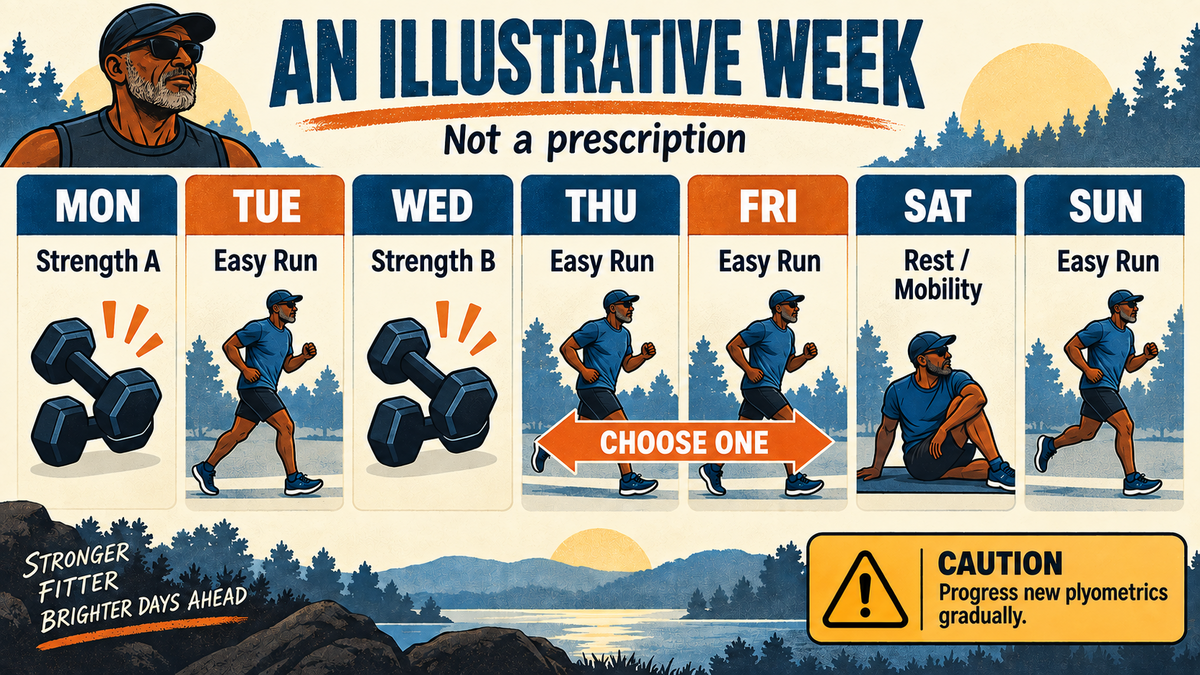
For a runner, the practical minimum may begin with one suitable exercise from each movement need, performed twice weekly on nonconsecutive days. Some movements can be combined. Volume can start conservatively and progress when form, symptoms and recovery support it. That is a starting structure, not a personalized medical or coaching prescription.
Strength, Running Economy and Injury Claims Need Different Labels
Strength training is often sold to runners with two promises: faster running and fewer injuries. The evidence is more interesting than a slogan.
A 2024 systematic review and meta-analysis found that high-load, plyometric and combined strength methods can improve running economy in middle- and long-distance runners, with the effects varying by method and running speed. That supports strength as performance training, not merely rehabilitation homework.
Injury prevention is less tidy. A 2024 review of exercise-based programs in runners found no clear overall reduction in injury risk or rate and suggested supervision may matter. In contrast, a 2024 randomized trial in novice recreational runners found fewer lower-extremity injuries with a physiotherapist-guided hip and core program, while its ankle and foot program did not show the same protective effect and recorded more acute injuries.
I don’t think strength prevents every running injury, nor do I think it prevents none. Program content, progression, supervision, the runner and the outcome being measured all matter.
“Spring” Is a Category, Not an Order to Start Jumping Today
Power deserves a place in an older-runner conversation because the ability to produce force quickly tends to decline with age. Running itself is a spring-like activity. Every stride asks the lower leg and the rest of the chain to accept, store and return force.
That does not mean every runner over 50 should begin box jumps on Monday. My calf-focused article explains why the lower leg deserves deliberate attention without reducing it to one magic exercise.
An age-adapted plyometric trial in older men improved strength, jumping and stair-climbing performance, but the researchers also warned about injury risk and the need for proper progression and supervision. “Spring” might eventually mean low-level hopping, skipping, jump rope, faster concentric lifting or another professionally selected power exercise. It might temporarily mean none of those.
The broader return began with my Ouch to 10K pivot. My current BlackToe Holiday 10K plan is a perfect example. CoachChat prescribed my existing strength routine twice this week on nonconsecutive days, told me not to add plyometrics or a new heavy-strength progression yet and kept the harder strength session away from the longer easy-endurance run. The category still matters. The timing matters more.
How I Use AI Without Handing It the Keys
My cornerstone article explains the larger AI running-coach experiment. I do not ask ChatGPT, “I am 67, give me a workout,” and then obediently perform whatever appears.
A 2024 study had coaching experts rate ChatGPT-generated running plans. The plans improved when the prompt included more information, but the authors still advised against using them without expert feedback. That finding fits my experience. Detail improves the conversation. It does not turn a language model into a physiotherapist standing beside me.
For strength and mobility, useful input would include:
- Current running history, race goal and training phase.
- Available training and recovery days.
- Previous strength experience and exercises I genuinely like.
- Equipment, space and time.
- Current or recurring pain, injury history and professional restrictions.
- Movements I cannot yet perform comfortably or confidently.
- The purpose of the block: general health, return to running, durability, strength or power.
AI can then help me audit the routine against push, pull, squat, hinge, step, spring and brace. It can flag omissions, suggest equivalent movements, explain why an exercise is present and propose a modest progression. I can ask it to reduce the plan until it fits my real week.
The human remains responsible for clearance, technique, pain decisions and common sense. A qualified clinician or coach should assess symptoms, movement limitations and unfamiliar high-load or high-impact work.
The Plan Should Evolve With the Running
Strength should not be pasted onto every training week unchanged. In a lower-mileage phase I may have room to pursue heavier or more demanding work. During a race build, the goal may shift toward maintaining strength without spoiling key runs. During a return from injury or deconditioning, the clever move may be to hold an exercise steady, reduce it or wait.
That is why I like the same transparent chain I use for the running experiment:
Coach prescription → Garmin FIT evidence → runner context → post-run assessment → multi-run trend comparison
The Garmin file cannot tell the whole story. It does not know what strength work I completed, how I slept, what hurt, which shoes I wore or whether yesterday’s split squats are still living rent-free in my quadriceps. Those details become context. Then the next plan can respond to the complete picture rather than one number.
If the alphabet soup is unfamiliar, my Training Metrics Made Simple guide explains the numbers in plain language. This is also where my late-blooming running-data nerd comes out to play. I have great fun drilling into pace, heart rate and cadence, but the data are a second layer of the running experience. They are not the reason every run exists and they do not get to declare a joyful run worthless.
A recent BlackToe session illustrated that nicely. The heart-rate strap misbehaved, but RPE, nose breathing, pace behaviour, stable cadence and symptoms still described a controlled run. The sensor had a bad day. The runner did not. My article on trusting your body more than your smart devices explores that balance in greater depth.
A Simple Way to Build a Routine Without Collecting Exercises Forever
If I were rebuilding my routine from scratch, I would use this process:
- Get appropriate medical or professional clearance, especially with pain, recent injury, chronic conditions or unfamiliar impact and heavy lifting.
- List the exercises I already know, tolerate and enjoy.
- Map them against push, pull, squat, hinge, step, spring and brace.
- Choose the smallest combination that covers the important jobs without unnecessary duplication.
- Place two manageable sessions on nonconsecutive days and protect key running sessions.
- Begin with a conservative load and range, then progress one variable at a time.
- Record enough context to notice whether the routine supports running or repeatedly leaves me too sore to run well.
- Review after several weeks. Keep what works, replace what does not and resist the urge to redesign everything after one imperfect day.
My own posterior tibial tendonitis history is one reason I take this seriously. It also taught me not to confuse a general framework with rehabilitation. A diagnosis, a painful structure or a return-to-run decision deserves individualized professional care.
A Possible Future Plus50Fit Resource
This experiment may eventually produce free downloadable Plus50Fit FIT Tools for Windows. The current Python tools connect the prescribed workout to Garmin FIT evidence and the context a device cannot record, then compare runs across time. If they are packaged for readers, strength and mobility would remain part of that wider context, not a machine-generated verdict that one exercise caused or prevented an injury.
That remains a possibility, not a promised release. The software would need broader testing, installation guidance, privacy and medical disclaimers, decisions about licensing and support, and a sensible way through Windows security warnings. FIT processing would remain local on the reader’s computer.
The Routine I Will Do Beats the Perfect Routine I Will Avoid
I enjoy running. I also enjoy asking what the data can teach me. Strength training serves both interests when it helps me keep doing the first and gives me useful questions for the second.
My seven words are not commandments. Push, pull, squat, hinge, step, spring and brace are a working audit that helps me see the body’s jobs without drowning in exercise variations.
The minimum effective routine is not the shortest routine on the internet. It is the smallest sensible routine that covers my needs, fits my week, respects my health and earns the right to progress because I keep showing up.
That sounds less exciting than a secret list of five perfect moves.
It also sounds much more likely to work.
Frequently Asked Questions
Is two days a week enough strength training for an older runner?
Two nonconsecutive days is a broadly supported starting target for strengthening all major muscle groups. Whether it is enough for a particular performance goal depends on exercise choice, effort, volume, running load, recovery and training history.
Do runners over 50 need mobility work every day?
Not automatically. Mobility should address the usable range a runner needs and any individually identified limitation. Strength through an appropriate range can also develop usable mobility. More stretching is not always the missing answer.
Should older runners do plyometrics?
Some appropriately prepared older adults may benefit from progressive power or plyometric work, but it is not a universal starting point. Health, current capacity, technique, injury history and supervision matter. “Spring” is a need to consider, not an instruction to jump before you are ready.
Can ChatGPT build my strength plan for running?
It can help research, organize and adapt a plan when given detailed information, but it cannot examine you, diagnose pain or verify technique. Use qualified medical, physiotherapy or coaching guidance when risk, symptoms or unfamiliar loading make that necessary.
AI Disclosure
I developed this article with AI assistance for research organization, source checking, structure and editing. The training experiences, opinions and decisions described are my own. I reviewed the final article and the linked sources before publication.
Safety Disclaimer
This article shares my experience and a general editorial framework. It is not medical advice, diagnosis, rehabilitation guidance or an individualized exercise prescription. Consult an appropriate healthcare or qualified exercise professional before beginning or changing training, especially if you have pain, injury, cardiovascular concerns, chronic conditions or uncertainty about exercise technique.